Sunday, March 12, 2006

What matters most...

A while ago, The Sun started a weekly feature called "Resident Speakout!" that solicits letters from the community on different topics. With targeted questions often meant to prompt controversy, it seems like a ploy to get more people writing.

The topics that are discussed in Speakout are often of significant interest and importance to the county -- affordable housing, county budget and tax policies, rural preservation, etc. There are often intelligent, thoughtful responses to these questions, though the number of writers is usually small. Certainly, these level of participation with these topics is nothing compared to the response generated this week when the question was about the prospect of The Biggest Grocery Store Ever coming to our little town.

It is all a matter of priorities, I guess.

Tell me how you really feel...

A mentor of mine often said that "nice" (along with "pleasant") was just about the worst insult you could recieve. David Wissing shows how right she was.

Saturday, March 11, 2006

Didn't see this one coming...

From today's Sun:

Howard County Executive James N. Robey vetoed a Republican-sponsored measure yesterday that would have trimmed the assessment cap on the taxable value of homes from 5 percent to 4 percent, a measure that would have saved the owner of a median-priced $450,000 home $46 a year.
But why? Why!?

Robey based his veto on three objections: that the cut is small and wouldn't take effect until 2007; that he is proposing a 3-cent cut in the property tax rate for July 1; and that with costs rising, the combination of both cuts would be a "significant loss of revenue."

"Significant loss of revenue" is a loaded statement. Sure, both cuts (or a combination of a property and income tax cut) would cost millions of dollars, which, to someone like me, is indeed a significant amount of money. But to a county with a $1 billion budget and a $20 million surplus, I don't know if the forgone revenue would really be that significant -- or at least so significant that it would imperil our high level of services.

And as long as we're parsing statements, how about is one from council chairman Chris Merdon.

"The Democrats want to have it both ways. If you cut taxes a little bit, they say it's too small and insignificant. If you cut them too high, they say it's irresponsible," Merdon said. Robey's proposal would save the same owner of a median-priced home $135 and begin a year earlier.

Um, so what's your point? It seems to me like he's arguing against finding a responsible middle ground here. The Democrats don't want it both ways -- they want more than a little and less than a lot, or in other words, something in the middle. Cutting taxes too much is indeed irresponsible, and cutting them too little is indeed insignificant. You don't base policy on extremes.

As for Merdon's "democrats want it both ways" comment, well, I've got two words: Pot, Kettle.

This is quite possibly...

The laziest post ever...

Howard County Blog #1 has all the details on 2007 county budget -- including the calendar, budget requests, and various budget publications. Go check it out.

Here's your chance...

To watch candidates get asked the tough questions.

RestoreUS.org, a local group with admirable (and lofty) goals, is sponsoring a candidate forum Wednesday, April 5 at the Glenwood Library in (strangely enough) Cooksville. The event starts at 5 pm with a meet and greet, and the show starts at 6 pm when the County Executive candidates take the stage. Following them will be the County Council candidates from District 5 and then the school board candidates.

Each candidate will have three minutes to make their opening statement, followed by questions from the moderator and panelists. Suggested questions can be submitted by anyone by sending an email here. The same email address can be used if you have questions about the forum.

Sounds like it should be a good event, and I hope to make it out for at least some of it.

Thursday, March 09, 2006

Now we're talking...

Before I get to the substance of this post, I want to start out by saying how great it is to be a part of a honest discussion of county policy (not politics). After my post yesterday on Charles Feaga's tax plan, which was prompted by Howard County Blog #1's post on the issue, HCB1 responded with further analysis and David Wissing even got into the act today. I think we have all made valid, reasonable points and have covered the issue more comprehensively than any newspaper.

Okay, that's enough blog triumphialism. On to the substance.

First, where I went wrong. From yesterday's post:

Well, in order for Feaga’s tax cut to actually amount to it’s $41 over seven years savings, property values in Howard County have to continue to grow at least 4 percent a year for the next seven years. This is entirely possible, but it’s also entirely possible that it won’t happen. Check out this website to get an estimate of your home’s worth, and then look at the graph of that value over the last 5 years. Twenty, 30, and 40 percent increases in property values are not sustainable - no matter what your real estate agent tells you.
Why is that wrong? Well, here's what HCB1 has to say:
Maryland uses a triennial assessment process. In that process one third of the County is reassessed each year and the assessment adjustment is phased in over a three year period. So revenue is predictable. If a triennial reassessment increase on a property is more than 15 percent, it will take more than three years to fully phase in the increase. Since the current assessment cap is at 5 percent and 5 goes into 15 equals 3 it will take three years to phase in the increases. This year the residentaial portion of the assessable base in the third assessment area (Northeastern third of the county) grew by an average of 74% from reassessments. If these properties remain with the same owner, it will take fifteen years for those properties to be fully phased in. We know not all homeowners are going to stay for 15 years, but at a 74% reassessment how many have to leave to meaningfully change the numbers? Now consider and add the other assessment areas of the county. Additionally, during this same time period those same properties will be assessed up to three more times before THIS assessment increase is fully implemented.
Yes, he's right about that. But I don't think that particularly matters.

The overriding point, which David Wissing gets at, is that projecting out seven, ten, or 15 years is not the best way to judge the worthiness of these tax cuts. While many folks will stay in the same place for the next 15 years, many will not. And for those who plan on moving to a larger house -- for instance, me and Wissing -- the phased in assessment is thrown out the window when you buy a new house; that is, you pay taxes according to the full value of the most recent assessment. Which means, essentially, that Feaga's tax cut -- though more significant in the long run -- is really only beneficial to those who are satisfied staying put for the long run.

Here's what Wissing had to say:

I live in a townhouse that has an present day assessed value of about $200,000 (let’s talk round numbers for simplicity). Next year, I will get a new assessment and based on what townhouses have been selling for in my neighborhood, I expect that number to grow to at least $250,000 (I wouldn’t be surprised to see it go even higher, but let’s be conservative). Regardless, since the increase in value is greater than 5%, each year the taxable assessed value of the house will be capped either at 4% under Feaga’s plan or 5% under Robey’s plan.

Then after three years, I am ready to move out of the townhouse and into a single family home. For a one-to-one comparison, I will use the value of a present-day $400,000 home in four years based on a 8% yearly increase in assessed value, which would be $503,885. When I purchase this new home, my property tax basis starts out at the assessed value of the home when I purchase it. So let’s adjust the tables used by both Hayduke and HoCoBlog for this analysis using the $200,000 townhouse for three years and the “$400,000″ house after that.

So instead of recouping my money in seven years, as both Hayduke and HoCoBlog agree to, it will end up taking me almost twelve years to see the greater benefit of Feaga’s tax cut over Robey’s tax cut. Prior to that, Robey’s tax cut is more beneficial to me.
(go to his post to see the table).

He then goes on to add what I think is another very important point (and assumption) in this whole debate. Taxes (and tax rates) are not and will never be static. If we're trying to project 15 years out from now, we're talking about three elections between now and then, three elections where the county executive and council could completely change. And I'm willing to bet the farm (well, my house) that we'll see a change in tax rates before our next county executive -- be it Merdon, Ulman, or Dunbar -- leaves office.

The further out we project, the more we are forced to discount the value of future savings -- both in terms of inflation and opportunity costs (i.e., net present value) and in terms of the likelihood of us actually seeing property taxes and rates stay the same, which I would (conservatively) say is between zero and ten percent. Also, it's always better to get your money from the government up front, rather than having to wait several years.

This is why I think Robey's plan is better. Every property owner will realize greater tax savings in the next four years, regardless of if they decide to move up and let someone else move in. Of course, like Wissing, I'm probably biased in favor of the plan that will benefit me the most. And personal bias is always better than political bias, especially during an election year.

Round Up: Columbia Flier Edition...

Some quick hits on stories from this week's Flier:

First, the strangest story of the week: 36 dead geese found dumped near a playground. Is there really anything I can say about this? No. Let's move on.

Now, this would be great.

A potential plan to study extending the Washington, D.C. Metro's Green Line to BWI Thurgood Marshall Airport could include a stop in eastern Howard County.

That stop would be in Guilford, near Columbia, according to a preliminary map of the proposed extension released by the General Assembly's Department of Legislative Services.

Of course, at this point, it's just a "potential plan to study" the possibility of a Metro extension, which at this point means just about nothing. But at least it's being talked about. Oh, and by the way, the price tag for extending the Green line to BWI would be about $3 billion, or $1 billion more than the Inter-County Connector.

Finally, the Howard County police have a couple new weapons in their arsenal: Hot Rods, specifically a Ford Mustang and a Dodge Charger. The sports cars are used for covert traffic enforcement, but now that a story has been written about the new cruisers, what does that do to their overall covertness? I actually saw the Mustang pull someone over a couple weeks ago on Rt. 29 (and, no, I wasn't the one being pulled over).

Wednesday, March 08, 2006

Clear math...

Following up on yesterday’s post, I’ve got more to say about the just-approved tax cut, which is really a decrease in the maximum allowable annual increase in your taxes, but for the sake of argument (and to please the Republicans) we’ll call them tax cuts.

The short story is: The council approved a measure that would lower the annual assessment increase from 5 percent to 4 percent. The county executive, meanwhile, has proposed lowering the tax rate by $0.03 per $100 of assessed value; because he is more in favor of the tax cuts that were his idea, naturally, Robey has threatened to veto the council bill, which was approved with votes from the two Republicans and David Rakes.

Now, with that out of the way, Howard County Blog #1 writes:

Don't let the effective dates and first year savings on these competing tax cuts fool you. Feaga calls it a very small decrease.

In the first year it is... Run the math on a $400,000 home and use the current property tax rates. The savings snowball over time. That 1% decrease in the cap is not insignificant - it is huge. I like that. It doesn't cut County revenue it limits the revenue.

Compared to Robey's tax rate cut proposal, which I like too, Feaga saves tax payers a lot more money over three years than Robey's plan. Take the math out 7 years and the savings are twice what Robey's plan proposes.
Interesting, no? First, the difference between revenue “cuts” and “limits” is semantic. Second, what about the math? Will taxpayers have a significantly lessened burden under Feaga’s plan?

No.

Before we can go to the numbers, we’ve got to understand the assumptions. Obviously, we’re talking about a $400,000 house. Also, in order to project out seven years we have to assume that everything stays the same - well, mainly that tax rates don’t change, which I would say is pretty unlikely, and that the owner remains in place the whole time. But for the sake of this exercise, we’ll make those assumptions.

There is one more assumption, but we’ll get to that in a minute. First, the numbers.
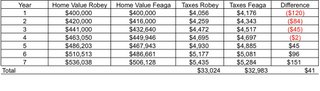


(The picture is clearer if you click on it.)

Interesting, no?

So, what does this chart mean? Under the “Home Value Robey” column is the value of our fictional home assuming Robey vetoes Feaga’s bill and implements his tax plan. The assessed value of the home goes up 5 percent a year and the tax rate is $1.014 per $100. On the other hand, the “Feaga” columns represent what happens if his proposal is passed and Robey’s is not; that is, the assessed value of the house increases at 4 percent a year and the tax rate is the same as it is now, $1.044 per $100 of assessed value.

As you can see in the “Taxes” columns, Robey’s plan saves homeowners more during the first four years, and it’s not until year five that Feaga’s plan takes over. However, by the end of seven years, it’s basically a wash -- $41 difference in taxes between the two plans.

But what about that last assumption? Well, in order for Feaga’s tax cut to actually amount to it’s $41 over seven years savings, property values in Howard County have to continue to grow at least 4 percent a year for the next seven years. This is entirely possible, but it’s also entirely possible that it won’t happen. Check out this website to get an estimate of your home’s worth, and then look at the graph of that value over the last 5 years. Twenty, 30, and 40 percent increases in property values are not sustainable - no matter what your real estate agent tells you. I don’t think we’re in for a busted bubble in Howard County, but I also don’t think we’ll be talking about sustained double digit growth either. As the graphs in the above website show, we are already seeing “leveling out” of home prices.

Feaga’s proposal is great when we’re in a time of rapidly rising property values. In other words, his proposal would have been great five years ago.

Given the immediacy of the tax bills - and the deferred savings from Feaga’s plan - Robey’s proposal is clearly the better option, at least if we’re concerned about cutting taxpayers a break when they need it most (Now!). The massive increases have been realized, and implementing a tax policy that is meant to stem additional growth in our tax burden would be not only late, but ineffective as well.

Tuesday, March 07, 2006

Another Round Up...

There has been a lack of good Howard County stuff to write about lately. So I'm forced to go the Round Up route yet again.

The Gang of Three (Councilmen Chris Merdon, Charles Feaga, and David Rakes) last night approved a reduction in the annual assessment cap for property taxes -- from 5 percent per year to 4 percent. County Executive James Robey has talked about his own tax cut -- reducing the rate by $.03 per $100 of assessed value -- but it's unclear if this is still part of his plan. It's also unclear whether he'll veto the Gang of Three's cut; he issued a strongly-worded threat to that effect yesterday. What's interesting is the Republican-sponsored tax cut would amount to less of a tax break than Robey's proposal.

A Howard police officer is suing the department over a potential free speech violation. As the story makes clear, there might not really be a case here because the department has since clarified it's position on who officers can talk to and when. Still, it's worth keeping an eye on.

Howard County Blog #1 takes Ken Ulman to task for sign-waving. A couple weeks ago, the Democratic County Executive candidate said he planned on waving but not until winter was over, which it is (at least according to meteorologists, but not the astronomers [and what do they know about weather, anyway?]). However, HCB1 infers that Ulman's decision to wave is a result of a poll he conducted recently or that he recognized how well the practice was working for his opponent, Chris Merdon.

Both of these reasons are wrong. Politicians wave signs because that's what they do. They sing and dance and generally make spectacles of themselves to get their name out there and hopefully grab a few votes. And even though I am morally opposed to roadside campaigning, they're not trying to win my vote.

I don't want to get into a partisan battle over something as silly as sign-waving, but it's important to remember that Merdon has been running for County Executive seat for at least a year, while Ulman was kind of thrown into the role after presumptive candidate Guy Guzzone backed out last fall. So if it seems like he's playing catch up to Merdon -- hence HCB1's nickname, "The Me Too Kid" -- it's because he is playing catch up, at least when it comes to gimmicks.

And now, for some random, non-local stuff I found in the blogosphere today.

Let's hope this doesn't become a fad. If it does, I might be in for a world of trouble. (See also David Wissing.)

Meanwhile, let's hope this fad continues.

Finally, ever wonder what The Simpsons would look like with real people? Wonder no more.

Well, that's all for now. Come back tomorrow for more, non-Round Up posts.

UPDATE: I forgot to include a link to this random internet tidbit. Apparently the judge in this case has a sense of humor.

Sunday, March 05, 2006

I've been (60 percent) of everywhere, man...

Here's a fun website. And here's where I've been.


Hmmm...looks like I need to plan trips to the northern corners.

Sunday Round Up: Oscars Edition...

To cynics, tonight's the night when a bunch of rich people get together to pat each other the back.

But, I'm not (usually) a cynic.

Although we have only seen a couple of the nominated movies, watching the Oscars is not just tradition in the Hayduke household -- it's an anniversary celebration. Back when I was just out of college and she was still in it, Abbzug and I moved into our first (tiny) apartment together the day of the academy Awards. Neither of us had a television, so we went out and bought the smallest, cheapest one we could find just in time to set it up (with rabbit ears) among the boxes and disorganized furniture in our new home and watch the broadcast. Today I can't recall which movies or actors won awards, but these aren't the details worth remembering anyway.

Okay, enough with the sentimentalizing, on to what you really came here for: a News Round Up. All today's stories come to use courtesy of the Sun.

A popular, successful program for middle school students at the East Columbia Library is out of money. The program, known as Teen Time, is so popular among students that there's a waiting list full of others wishing to get in. With all of its support coming from one-time grants, Teen Time will have to close down in June unless more money can be found. The programs total cost is slightly more than $33,000, which I guess is more than we can spare in our $1 billion plus 2007 budget. Instead of allowing this program to end, we should be starting them all over the county.

After an unsuccessful attempt two years ago, it sounds like the mega-grocery store Wegmans is still trying to find a suitable site in Columbia. The focus is on a parcel across from Apple Ford, an area that could easily absorb a 140,000 square foot grocery store (I already refer to that area as the Snowden River Parkway Big Box District). However, as was the case last time, there is still some concern about the impact a Wegmans would have on our village centers. But as was not the case last time, the Rouse Company is gone and its successor, General Growth, does not own the village centers and therefore does not have a financial stake in what happens to them. What's most interesting about this story is the amount of secrecy -- anonymous quotes, "neither confirm nor deny"-type statements. It's a freaking grocery store, not national intelligence. Sheesh.

How do you feel about the Wegmans? Tell me in comments or the Sun to have your opinions shared with a (slightly) larger audience.

Me and you, and you and me. No matter how they toss the dice, it had to be. The only one for me is you, and you for me. So Happy Together. See? That wasn't hard.

Look, I'm no sissy, pinko Communist, though I do love universal health care as much as the next wild-eyed, Che Guevara worshipping, capitalism hating socialist. I'm a big fan of property rights -- maybe not as much as this guy, however, who, like Communists, is really just a Utopian. (Turning everything into private property will not solve all the world's ills. T. S. Eliot pretty much sums up the problem with Utopians: "It is impossible to design a system so perfect that no one needs to be good.")

Anyway, it's not my intention to turn this last bit into a diatribe against Absolutists, Utopians, Communists, or Extreme Libertarians, including HoCo Exile. Rather, I'm writing about Sen. Allan Kittleman's ill-conceived attempt to change the state's constitution for local purposes. Thankfully, his bill, which would have limited the eminent domain powers of Howard County by amending the constitution that applies to every county, failed to win approval from the delegation. As it should.

I know people are hypersensitive about eminent domain following the Supreme Court's ruling last fall. But this is not the right way to address it.

The General Assembly is considering 43 bills on the subject, but Republican state Sen. Allan H. Kittleman was pushing a state constitutional amendment that would apply solely to Howard County.

Kittleman's bill, if approved, would have prevented county government from ever taking land for "urban renewal," even if the county, for example, wanted to acquire a vacant lot on U.S. 1 to aid a redevelopment project.

"Someone has a right to have a vacant property," Kittleman said at the delegation meeting in Annapolis Wednesday. The bill -- the delegation's last piece of local legislation -- failed, with support from only the 11-member delegation's four Republicans.

Democrats, led by Del. Elizabeth Bobo, who heads a House subcommittee working on land-use issues, said that with all the bills submitted on the issue, it would make sense to see what legislation emerges from committee before trying to amend the state constitution just for Howard County.

"Our goal is to get uniformity throughout the state," Bobo said, and that would be better done by changing state law through the legislative process than by amending the state constitution.

County Executive James N. Robey, a Democrat who attended the meeting, also opposed Kittleman's bill.

"We rarely used [eminent domain], but I think any jurisdiction would want the tool to use in unusual circumstances," he said.

Kittleman's reacting to an emotional issue, which is usually the best way to come up with bad policy. I'm in favor of more controls and clearer, stronger definitions on when and where eminent domain is appropriate. Let's see what comes out of the 43 other bills first before we start changing the constitution.

Friday, March 03, 2006

I lied...

Yesterday I said there was a lot I wanted to write about, but I didn't have time to cover everything; it was a cheap excuse to get off the computer before the only two television shows that I watch with any regularity began -- My Name is Earl and The Office. Interesting fact about Earl: The show appears to take place in Maryland, as Hagerstown, Cumberland, Frostburg University have frequently been mentioned, though the actual location mentioned is always "Camden County." But enough about TV.

The point of this post and the title is to say that really there wasn't as much to write about as I thought. Sure, there are a bunch of stories in yesterday's Flier, but most of them deal with things we've already covered. For instance:

  • "Accident reporting flawed" is discussed here and here. (Since the news about the misidentified bottle of tanning oil broke last Wednesday past Patuxent Publishing's deadline, their story from last week ran with a reference to the police finding alcohol in the car).
The only story that's actually news is "CA board lowers cap, raises fees." But really, who wants to write about that?

I'm not trying to make the Flier look bad. On the contrary, I think the paper is generally pretty good and it certainly offers the most comprehensive coverage of Howard County issues. I'm pointing this stuff out to try and help them.

The Flier (and the Howard County Times -- sorry, it's my Columbia bias) are always late to the party, and they will be always if they don't bother changing. Being a weekly publication means you're going to get scooped on pretty much everything and therefore it requires you to adapt either by offering more detailed analysis, which the Flier rarely does, or by finding stories that others miss, which the Flier does at least intermittently. But it doesn't have to be this way.

Why must the Flier enslave its writing and publishing schedule to the tyranny of dead trees? They have a website and I'm pretty sure they've got someone who knows how to update it. So, why don't they at least post short, breaking news items as they occur instead of waiting until the next Thursday, by which time the Sun and the Post (and your dedicated Howard County bloggers) have already covered all (okay, most) of the ins and outs? They don't have to post full-length stories, but daily updates would go a long way to regaining the relevancy of these papers.

Maybe the Sun, which is owned by the Tribune Company (which also owns Patuxent Publishing) is worried about a local weekly competing with its daily. But that's bunk. The Post owns The Gazette Newspapers in Carroll, Montgomery, and Prince George's counties and these weekly papers post daily updates on their website, presumably with permission from the parent company.

So, how 'bout it, Patuxent? How about entering the digital age? We're all here and there's still plenty of room.

WOOOOOOO-HOOOOOOOO!

When I started reading this article about the trendification of the Columbia Mall, I was overwhelmed with apathy. Then, about halfway down, I read this:

An Apple store is scheduled to open in early summer on the upper level near Hecht's...
And all my emotion came flooding back.

It's going to be a good day.

Thursday, March 02, 2006

Light day

Plenty to write about today, but no time to write. It's hard to live up to yesterday's barrage of post, alas. However, if I write less today it means I've got more to write about tomorrow and this weekend. No need to rush.

Before I sign off for now, I've got a movie recommendation. So here it is, the first installment of Flicks Hayduke Picks (in case you weren't aware, I like having regular features -- it is an easy way to fill space and it gives me a chance to use capital letters).

You should see Walk the Line. Even if you don't like Johnny Cash, which is reason enough for you and I to never be friends, the movie is still worth a trip to Blockbuster or your mailbox if Netflix is your preferred entertainment provider. (Yes, I'm biased. I'm a huge Johnny Cash fan and there's a soft spot in my cold heart for Reese Witherspoon, but that's not the point).

I do have two complaints. The movie was too short and I wasn't as impressed with Joaquin Phoenix's voice as other, more credentialed critics were. Don't get me wrong, he did a great job; it just was not perfect. But a perfect replication of Cash's voice would have been impossible. I guess the important thing is that his voice didn't detract from the movie at all, and most viewers probably wouldn't know (or care) about the difference. I'm a snob when it comes to these things, though.

So, that's it. See the movie. But first, a reminder of why Johnny Cash is truly a legend.

Well, we're doin' mighty fine, I do suppose
In our streak of lightnin' cars and fancy clothes
But just so we're reminded of the ones who are held back
Up front there ought 'a be a Man In Black
Also, here's a great quote I found on his Wikipedia page.

"I did not vote for Mr. Bush, let's leave it at that."

Upping the ante

County Executive James Robey is proposing an increase in the amount of money the county offers rural landowners for their development rights, partially in response to the likely high costs of preserving Doughoregan Manor.


Robey (D) said last week that the county should be allowed to pay up to $40,000 an acre for development rights on farmland, close to what developers pay farmers for building rights in the county's rural west. That would make Howard's maximum payment among the highest in the country, according to county and state officials.

The County Council will consider Robey's proposal during a March 20 public hearing and might vote on the resolution in April.

Robey's proposal comes as county officials, working with the state, are trying to preserve all or a large portion of Doughoregan Manor, an 892-acre estate west of Ellicott City that's the ancestral home of Charles Carroll of Carrollton, a signer of the Declaration of Independence. Richard Talkin, the Ellicott City attorney representing the Carroll family, which owns the estate, has urged the county to double what it is willing to pay to preserve at least 600 acres of Doughoregan, which lies south of Old Frederick Road and west of Folly Quarter Road.

Robey said his effort to increase the maximum payment goes beyond Doughoregan. He said he's also trying to deal with the fact that farmers are no longer placing their land in the county's agricultural preservation program and instead selling it to developers.

"We haven't had property come into the program since 2002," he said. "We do this or give the whole thing up and walk away."

No takers in four years? I'd say it's probably time to sweeten the deal. And, apparently, the county council, or at least a majority of it's members, agrees.

A majority of the Howard County Council said this week that they will support an initiative by County Executive James Robey to double the maximum per-acre amount the county government can spend to preserve farmland.

Although I'm still in favor of transferable development rights (and have even heard rumblings about such a program) that would allow landowners to preserve their land and force developers in other parts of the county (cough, GGP, cough) to buy additional density if they want it, I am more in favor preserving our dwindling supply of farmland, regardless of how it's done.

Wednesday, March 01, 2006

Livesay's staying...for now...

County Executive James Robey and Police Chief Wayne Livesay got together yesterday to talk about the chief's future. Here's what went down...

Over fruit cup and eggs at an Ellicott City diner yesterday, Howard County Executive James N. Robey and Police Chief Wayne Livesay decided that Livesay will remain in office for at least several more months while he runs for County Council.

Robey said Livesay would leave his job as chief to campaign, but not until the Police Department completes a reaccreditation evaluation.

"I asked him to stay at least until accreditation is over," Robey said.

Honestly, could they have thought of a better place to do this than at a diner? That's perfect! Two cops -- one current, one former -- talking about life, politics, the future over eggs and fruit cups. You really couldn't script it any better.

Livesay's decision to run has opened up some rifts in the Republican machine.

County Councilman Charles C. Feaga, a western county Republican, has jumped firmly on Livesay's bandwagon, while state Sen. Allan H. Kittleman, who held the council seat for six years, is just as firmly behind Fox.

"I want someone to represent us who knows that section of the county," Feaga said. "[Livesay] went to school at Glenelg High with some of the farm kids out there. He knows [the area] so well, and he's very active in his church -- a religious person."

...Said Kittleman: "I don't think Wayne Livesay has much support in the party. The rank and file do not support Livesay. He's got a lot to answer for."

As I said yesterday, I'm not really concerned about a conflict of interest and I don't particularly care that Republicans are upset. But among bloggers in Howard County who talk about politics, I am in the minority. Both Howard County Blog #1 and David Wissing are concerned about Livesay less-than-solid commitment to the GOP. Here's Wissing's take:

What is also interesting is all the quotes from Democrats that I have seen recently, including in this article from current councilpeople Ken Ulman and Guy Guzzone, which are very favorable towards Livesay. In fact, I havenÂ’t seen one single negative comment from a Democrat about Livesay since he hinted he might run and it is almost like they are hoping he wins. That alone should make any Republican nervous. Since the district is overwhelmingly Republican, the only real way Livesay could win a general election is as a Republican. However, what would stop Livesay, should he get into office, from switching parties again back to the Democrats? Based on his past history and his publicly stated views on certain issues, absolutely nothing.

Because the district is so solidly conservative, it is certainly understandable that the county's Republicans want to see someone win who is going to toe the party line and not ally themself with the "other" side (e.g., councilman David Rakes). Although, it would be kind of poetic justice if Livesay won and that turned out to be the case.

Tit for tat

I don't really have anything to say about the ongoing Turf Valley Mess, but I found this excerpt from today's Sun to be highly amusing. It's about Frank Martin, an Ellicott City resident who is leading the charge against the golf course community's expansion.

Martin said County Executive James N. Robey is friends with Nicholas Mangione, the patriarch of the developing company, and is determined to win approval for Turf Valley's expansion.

"It's how business gets done," Martin said. "I give you money to get elected, you approve my projects."

He accused the Department of Planning and Zoning of being under Talkin's thumb, and he said Talkin "was trying to rewrite history in his summation."

Those attacks complete a clean sweep for Martin, who openly challenged the integrity and competency of the Planning Board.

Some reporter has a sense of humor. Unfortunately, as the Sun has taken to doing recently, this story was published on-line with the byline "By a Sun Reporter." So, we'll never know who actually wrote it.

What's that about, anyway? Scared to put your name on what you write, "Sun Reporter"? Can't take responsibility for your thoughts and words? Wimp.

Wait, I meant to say, keep up the good, anonymous work! There's nothing better than forsaking accountability!

Lien payments without representation...

Bureaucracy at its finest.

Linda Wengel lives in the heart of Columbia and wants to run for a seat on her village board this spring, but she can't.

Wengel's new apartment at the Evergreens, in a building for seniors next to The Mall in Columbia, is -- like every other new building in the planned town -- in a legal purgatory.

Owners of new buildings must pay the taxlike property lien to the Columbia Association, but the buildings have not been legally annexed into Columbia, so their residents can't participate in village affairs. The problem is the result of a January 2003 change in practice by the U.S. Department of Housing and Urban Development, which was used to perform annexations because the only other method requires getting approval from at least two-thirds of a village's eligible residents -- a virtual impossibility because most village elections attract a bare minimum of voters.

Why is HUD even involved in the first place?

Patricia B. Laidig, Town Center village manager, said the Federal Housing Administration, an agency of HUD, has been used to accomplish the annexations since 1983 because the other method, requiring approval from two-thirds of eligible voters "is nearly impossible to achieve," she said.

Should I ask again, or can someone with more knowledge explain why we need HUD to annex new development into our city?

From the same story, how's this for an understatement:
Town Center is the least populated of Columbia's 10 villages with 4,636 residents, though plans for intensive urbanization of the downtown core may change that over time.
It "may" change? Geez, this article raises more questions than it answers.

Master plan meeting recap

The Sun provides the play-by-play from Monday's master plan meeting.

A proposal to transform the heart of Columbia into an urban downtown drew polite support in general but also pointed criticism as officials faced the public for the first time with a broad blueprint on how to achieve the plan.

The response was not unexpected, but it may nonetheless force officials to abandon their time schedule for enactment of legislation that is critical for the plan to advance.

Indeed, that schedule was a principal point of contention during a 3 1/2 -hour presentation and discussion Monday night.

But Marsha S. McLaughlin, planning director, said after the meeting that the time schedule might have to be adjusted.

"We have to look at that," she said. "We have to keep answering questions. I'm not suicidal. I don't want to take something to the Planning Board or the Zoning Board that's going to be a big shouting match."

Well, it's good to see McLaughlin's maintained her sense of humor (and self-preservation).

Slowing things down may well turn out to be the best thing to do with the plan. However, there's a difference between slowing the plan down to get it right, and slowing it down in hopes of derailing it altogether, which is the aim of at least some of the plan's current opponents.

Later in the article, the problems some have with the plan are addressed -- specifically, the lack of affordable housing, traffic studies, and a plan for who will pay for the necessary infrastructure improvements and how. Traffic studies will come -- DPZ assured us of that on Monday -- and infrastructure will be paid for somehow -- here's my suggestion. But what about affordable housing?
Concern over escalating housing costs and the resulting effect of Columbia becoming increasingly exclusive were a major theme of the meeting.

The county's plan includes a provision to require developers to set aside 10 percent of all housing units in downtown Columbia for moderate-income families and 5 percent for middle-income earners.

"We're trying to accommodate different housing needs," Lafferty said before the meeting. "Jim Rouse had that as part of his commitment" when he envisioned the creation of the planned community decades ago.

I hope that the No Growth folks aren't the same ones pushing for more affordable housing, as this is about as dishonest a stance as you can take. The reason Rouse was able to provide a wide range of housing options to meet the needs of everyone was because he was able to build A LOT of houses. The more we restrict the supply of (new) housing, the more exclusive we'll become, and with the spigot all but turned off for Columbia, we're probably looking at increasing income-class gentrification.

To be sure, developers, when given the right to build houses, need to build a range of housing options, including apartments, townhomes, small detached, large detached, and (shudder) McMansions. However, the only way they can do that is if we structure a plan and zoning regulations that allow them to. Rouse didn't need a 10 percent, 15 percent, or any percent set aside for affordable housing. He built enough houses in enough sizes and iterations for every income bracket.

So instead of arguing about percentages -- thereby creating an hourglass distribution of income in Town Center (with a bunch of expensive housing, some moderate income housing, and nothing in between) -- we need to compel developers to build a more balanced distribution.

Of course, another solution to stem the increasing exclusivity of Columbia is convincing existing homeowners to sell their houses for less to people of certain income brackets.

Care to implement that policy?

Working hard for our money...

Will the Columbia Association be the next Enron?

The Columbia Association is forming a purchase co-operative that will give residents and businesses in the community the opportunity to buy electricity at a discount rate.

Prices will go up in July when the six-year state regulation on electricity expires. Baltimore Gas and Electric Co. customers reportedly will pay 40 percent to 80 percent more.

...Karen Hawkins, a spokeswoman for the association, said specific details of the co-op, including those who would be eligible, are still to be decided. She said the co-op is expected to begin by early May.
Because of CA's unique position as a homeowners association/quasi-government/nonprofit organization, it is able to buy electricity wholesale and pass the savings onto us (or at least those of us who live in Columbia and opt into this program). Although savings won't be terribly large -- between 6 percent and 11 percent -- any little bit helps.

I can't think of any reason why this would be a bad thing, but I'm not an economist. Here's what practioners of the dismal science have to say about the co-op.
"There is no guarantee that [a cooperative] will be favorable," said Steven Estomin, a senior economist for Exeter Associates, Inc., a Columbia-based economic consulting firm. "The problem is you never know when the market is going to go up."
Um, unless I'm misunderstanding, I think it's pretty clear the "market is going to go up" once the state regulations are lifted. Anyway, back to the experts...

Art Holland, director of power and forecasting for Pace Global Energy Services, an energy consulting firm in Fairfax, Va., said: "It's a price uncertainty, and it's also a volume uncertainty, as well. The volume uncertainty is not knowing what the demand will be with exact certainty."

"If it's hot, people are going to turn up their [air conditioners] ... and it's driven by weather," Holland added. "It's a risk you have to manage effectively, and if they don't, their customers will pay."

Aren't we going to pay either way? I'm not quite sure what these guys are getting at, but then, I'm not really giving this much thought; too many other things to write about.

If you know of a reason why this is a bad move by CA, let me know in the comments section.