Tuesday, September 05, 2006

Airing dirty laundry...

The Republican primary in District 5 just got a little less crowded (not that it was ever really crowded in the first place).

Jim Adams, who was refreshingly candid about his chances of winning, has exited the race and thrown his support behind former police chief Wayne Livesay. Adams’s reason for leaving: “dirty politics.”

“The first reason is that there was a slim chance that I could win, but more importantly, I have recently become aware of what I refer to as dirty politics,” according to Adams’ speech given Monday at Chris Merdon’s campaign headquarters.

…“There are various items that the opposition is wrongly addressing and I will not go into them, with one exception. That exception addresses Wayne Livesay as a Republican,” according to Adams’ speech.
Of course, dyed-in-the-wool Republicans don’t have a problem with pointing out Livesay’s disloyalty and certainly don’t view such actions as “dirty.” However, on the Hedgehog Report, Adams goes into a little more detail about his decision.
Greg is running scared, he has no confidence. He had a push telephone pole conducted, omitted me, and used trash questions in reference to Livesay, and has not released the results. Greg is not impressing me as a man of good character, although I want to be wrong about this, his actions are disappointing me. I made my decision after conversations with MANY GOP members. None Recommened I drop out, some even suggested, without my prompting them that I stay in. It was in these conversations that I found out my conclusions about Greg’s campaign were not mine alone. I have always placed people before party...
Still, the full details of what he calls “dirty politics” remain elusive. Anyone who has been following this race at all, however, knows that it is highly charged and borders on what could be called “dirty.” Although I think David Keelan’s work on the Hatch Act issue was generally quite good, he has continued to target Livesay and sometimes, I would argue, crosses the fuzzy line. This is from last month.

Remember to stay on message and that Wayne Livesay is:

  • An Opportunist (switched to the GOP to run in a GOP district)
  • Doesn’t have the convictions of his beliefs (switched to the GOP to run in a GOP district even after he publically and loudly disowned the GOP)
  • Won’t endorse Sandy Schrader
  • A Republican in Name Only
  • Doesn’t trust that citizens know that comp-lite was a complete farse
  • Listens to Charlie Feaga too much
  • Precided over a police department leading to two sexual harrassment lawsuits and chalks it up to disgruntled employees (read the court records - they don’t sync up).
  • Doesn’t possess the grasp for details to be a legislator

My concern is that if we don’t stay on message and allow ourselves to be distracted then Wayne Livesay will win.

Although some of these items are just silly, partisan things, others are character attacks that rightly qualify as dirty. For instance, the last one, which basically amounts to calling him stupid. Livesay ran the police department admirably for almost a decade and yet he somehow doesn’t have it in him to decide on county-level legislation? That’s the easy part. Try implementing it.

Also, I would argue that it takes stronger convictions to leave a party than it does to blindly follow one. But that’s just my opinion.

Finally, hammering the point home about the ugliness of this race is the third comment – an odd, foreboding one made by timactual -- on Keelan’s post about this story.
There is another reason that Adams withdrew, but I do not want to get into that. He knows what I mean.
May the best man win, indeed.

Sunday, September 03, 2006

I'm not really here...

I'm technically taking the weekend off from blogging -- this doesn't count. But if you're looking for something to occupy your time for a while, Evan posted what I think is the entire Harper's Choice candidates forum. He cut the video into several pieces -- each one covering a single question -- which makes it easy to navigate through the two-hour-plus forum. It's still a lot of videos, though.

Go spend some time there enjoying the new age of blogging in Howard County.

Oh, since I can't resist, here's another link or two.

This is, appropriately, the top story in the Howard section of today's Sun, even though we've known since February it was likely. I'm still excited.

I went back and forth on drawing attention to this, but, whatever, it's a story of interest. That you can see how bad I need a haircut is, well, just a chance to get to know your neighborhood blogger a little better.

That's it till Tuesday.

Friday, September 01, 2006

Friday Round Up: Tropically-Depressed Edition…

Ah, Ernesto, we hardly knew ye. From storm to depression in only a few short hours, you’re now just a little breezy and (hopefully) a lot rainy. Which is fine. We need the rain more than we need the wind. Anyway, here are a few stray thoughts before the dog and I go play in the rain.

This is a good idea: Giving tax credits to those who conserve energy by installing solar or geothermal systems.

Wisely, a developer hoping to build senior housing near the Columbia Medical Campus in Thunder Hill has withdrawn his plans after strong neighborhood opposition.

What?!? Is General Growth seriously even contemplating demolishing the Rouse Company building? Don’t they know what happened last time they tried to take down a Frank Gehry-designed building in Columbia? Do they really want to open up that can of worms again?

Cut down to size...

It looks like the total number of buildings in Howard County reaching 20 or more stories will be one, the Plaza Residences. Interestingly, it doesn’t appear that shorter buildings will be the product of some strict government regulation. Rather, such heights have been found to be unnecessary in completing the more-urban vision of Town Center currently being refined.

Responding to broad public concern, a height limitation of 14 stories for new buildings in downtown Columbia is under consideration by the county.

…Whether 14 stories would be an unconditional cap, or simply a general target that could be exceeded in some instances, has not been determined.

There remains the possibility that a final plan might propose the limitation but make it flexible so developers could construct taller buildings in return for public improvements, such as new roads, constructing "green," or environmentally responsible, buildings, and cultural or civic centers, said Elmina J. Hilsenrath, division chief of Environmental and Community Planning.

A draft of the plan for downtown, released to the public in February, had included a limitation of 20 stories.

…"We've been dancing around the issue for many, many months," Hilsenrath told a focus group studying the future development of Town Center. But, she said Wednesday, a computer analysis showed that virtually the entire plan could be achieved by enacting a lower height limitation.
Some may look at the idea of a “flexible” limit as a way to quell opposition while winking to developers. This would be wrong.

Like the two leading contenders for county executive, I don’t support firm height restrictions in Columbia or elsewhere in Howard County. This is not to say I’m in favor of tall buildings; instead, it reflects my belief that we shouldn’t impose our preferences on others, especially those who don’t currently exist.

In most cases, getting a law on the books is easier than taking it off. And this is probably true with respect to height restrictions, too. While tall buildings may run completely counter to the prevailing opinions of today, the preferences of future residents may be dramatically different. Yet, should we enact such controls, citizens twenty years from now will be stuck under out collective thumb.

A better way of ensuring heights aren’t out of whack is creating an explicit provision in the zoning regulations that allow oversight bodies to restrict building heights based on the character of the neighborhood and acceptance of the community. Granted, there is still some mushiness in this, but it’s better than what led to the Plaza being approved and it still offers flexibility for residents of the future to actually chart their own course.

On Dunbar...

Harry Dunbar gets a story today in The Sun. Like the man himself, it’s full of comedy but is only funny to a point.

The 62-year-old federal retiree and real estate agent has based his campaign on dissatisfaction with the pace of development, making flamboyant, often inaccurate charges about the most sensitive political issue in the county this year.

At a candidates forum Monday night in Harper's Choice, Dunbar again assailed plans for a high-rise near Lake Kittamaqundi and the redevelopment of Town Center, recalling the green open spaces when he arrived in the new town from New York City in 1973.

"That's when I feel we had the highest quality of life because we had uncrowded schools and less density," he said, adding there "were no cars and no noise."
OK, I’ll admit it: I laughed out loud when I read the “flamboyant, often inaccurate charges” part. That was funny.

What’s funny in a less “ha, ha” way is his statement about how great life was in Columbia in 1973. Is he serious? How could he have moved here then and not known about what the future of Columbia would look like? Models, drawings, brochures and other materials all displayed for anyone with eyes what the “Next American City” would look like. And, not surprisingly, it looked a lot like what we have now.

Let’s get back to those accusations.
He has accused Ulman of making "backroom" deals with developers to allow construction of the proposed 23-story high-rise in Columbia…”

...As for the 23-story Columbia high-rise, Ulman said he has never met "with anybody affiliated with the project," much less in a "backroom deal." Dunbar acknowledged that he has no firsthand knowledge of such a meeting, and though he claims he read about it in a newspaper account, he cannot produce a copy of any such article.

Ulman has been frustrated hearing the accusations, which he said go beyond normal standards of campaign criticism.

"I do not mind being criticized. That's part of the job. What I mind is when people lie about me. When people cross the line and make things up," Ulman said.
I don’t care how you feel about Ulman, but he’s completely right here. If you think flat-out lying about someone to further your own goals or views or partisanship is fine, you don’t deserve to be heard. As good as it is to have Harry Dunbar around for comic relief, his quixotic quest sets an example of dishonesty that only perpetuates a climate of hostility, one where unsubstantiated attacks are not only acceptable, but the preferred method of debate.

Meanwhile, Ulman also had this to say in the article:
"I am proud to have stood up strongly in supporting investing in our quality of life," he said at a recent forum.

However, he said more work needs to be done on the plan for downtown Columbia, which includes adding 5,500 housing units, stores, offices and a hotel.

"I thought 5,000 units is ludicrous. The vision that emerged from the charrette is too intense. It wouldn't work," Ulman said.
Now, here’s a question for you. I’ve heard a lot of people say that Ulman has no limit to the development that he thinks is acceptable. Yet, here’s an example to the contrary. Does anyone have a link/citation to an article or anything where he said he supported the 5,500 units for Town Center? If my memory serves, Ulman’s been fairly quiet on the downtown plan since around the time of the charrette, saying at most that he supports the process and those working through it.

TV time...

I can bite my tongue no longer:

The Wire is the best show I have ever seen. By far.

I know that statement may seem a touch hyperbolic, but you must trust me, it is not. On the surface, it’s just a show about police and drugs in Baltimore. Underneath that, it’s a show about everything.

Actually, calling it a show is probably not appropriate. Though I’m not sure what the best term would be – I’ve heard stuff like “visual novel,” which doesn’t quite cut it -- The Wire is certainly beyond normal television.

The City Paper has a long story (that you should read) about the show and its writers, David Simon and Ed Burns, a former reporter and cop, respectively, who also wrote one of my favorite books, The Corner: A Year in the Life of an Inner-City Neighborhood (Simon was also the writer and creator of Homicide: A Year on the Killing Streets and the accompanying television show).

Since I've always lived in HBO-free houses, I never had a chance to see the show. But after reading The Corner last year and a lot of buzz about The Wire this summer (the fourth season starts next week), Abbzug and I decided to rent a few DVDs from season one.

That was a little more than three weeks ago. We finished season three on Tuesday. Thirty-nine episodes in 20-some days. It got to the point where Netflix couldn't keep up and we had to make special trips to Blockbuster and Hollywood Video, the latter being the only of the two stocking seasons two and three (and it might have been cheaper just to buy all three seasons). Many late nights we would finish an episode or two transfixed, precious minutes of sleep passing by, and without hesitation watch another.

Our complete devotion to the show, however, is not unique, either. Spend some time reading about The Wire on the internet and you’ll find countless others like us. For instance, here, here, here and here.

Like all addictions, The Wire takes its toll. But unlike most, it’s completely worth it.

Sun endorsements...

Buried in an obscure corner of cyberspace are The Sun's endorsements for county council races. Here's the link, which I just happened to stumble upon.

Anyway, in the more hotly contested council races, Democrats in District 4 and Republicans in District 5, the Sun selects Mary Kay Sigaty and Wayne Livesay.

In the other races, the paper sided with those you would expect it to.

Thursday, August 31, 2006

It's the schools, stupid...

Although Fort Meade is in Anne Arundel County, the impact of thousands of additional personnel will most assuredly be felt on the other (better) side of the tracks here in Howard County. No matter how much we control development or pull up the welcome mats for new residents, many of the 5,300 military jobs plus however many private jobs follow in their wake will be held by people who want to live in our county much more than in neighboring counties.

Why?

With nearly 4,100 Defense Information Systems Agency jobs set to move to Fort Meade by 2010, there was no shortage of people asking Kent Menser, the head of Howard County's BRAC task force, questions as he worked at a local fair booth in northern Virginia this summer.

Many of the employees slated to relocate now live in the Fairfax County school district, one of the most recognized districts in the country. Four Fairfax public high schools were listed in Newsweek's May issue of the Top 100.

So when DISA employees heard Howard County students averaged one point higher than Fairfax students on the SATs, many parents' interest were piqued, Menser said.

“…the schools in the county will be a magnet for folks," [Superintendent Sydney] Cousin said.
This is not wishful thinking on the part of some pro-development lackey. This is reality, and it’s the price we pay for being damn near the best in almost every quality of life index, survey or ranking out there (except, of course, for commute time).

The question is: How do we maintain our, for lack of a better word, greatness in the face of pressures and circumstances we cannot control? I refuse to believe that we can simply preserve what we have while the world around us changes. We cannot ignore or hope our way out of BRAC.

Thankfully, however, a committee is studying our predicament. And at least one member’s saying things that are sure to meet resistance.
The influx of service members and military civilians and their families have school officials attempting to project how many students will move into the county and when those moves will take place, despite limited information.

"Right now we don't have enough information to answer those questions," said Sydney Cousin, superintendent of Howard County public schools and a member of the Howard County BRAC Task Force, in an interview after the meeting.

Cousin said he expects the county will likely be forced to revise its general plan, a Department of Planning and Zoning document that is updated about once a decade and is considered the guiding document for Howard County's growth.
Changing the General Plan, huh? Although I’m not sure where I stand on that, the fact that our growth-guiding document was drafted before circumstances changed significantly certainly presents a valid argument for amending it.

Of course, it’s still early in the BRAC process and in the task force’s existence. Many details are still unknown and likely will be until the moving vans arrive. The best we can do know is act on what we know and adapt as the situation warrants.

In a move that should put a smile on even the most hardened cynic’s face, Menser, a retired Army Colonel, is looking for a few good men and women.
"There are a lot of bright people in Howard County. I want to put that intellect to work," Menser told an audience of about 25 people who attended last week's meeting.

He urged people with special expertise to volunteer for one of the task force's committees that work on areas from transportation to grant writing.
The next meeting of the task force will be Wednesday, September 6 at 3:30 pm (again with the freaking daytime meetings) at the county building in Gateway. If you’re interested in serving on a committee, the county lists this phone number for Menser: 410-313-3410.

Patuxent endorsements...

Patuxent Publishing released endorsements for primary races today. I can’t say if the list is surprising or not, but here are a few of the company’s more noteworthy choices:

House of Delegates District 13
(vote for three)
Democrats: Shane Pendergrass, Neil Quinter, Frank Turner
Quinter exacts some revenge for being left off the hat. But how much of an impact does this endorsement have in a race that’s comprised of pretty well-known folks, aside from Nina Basu, who probably deserves to be more well-known (oh, right, only when it’s her turn)? Also, Guzzone's got way more money than everyone else, and as David Keelan says: "Don't county him out."
County Council District 4
Democrat: Mary Kay Sigaty
I’m not sure if this is her first endorsement, but Sigaty’s generally been passed over by the traditional Democratic endorsees (unions, environmentalists, etc.). Rather than adding clarity, this endorsement confuses things. Will regular voters focus more on the paper’s endorsements or will they align themselves with an interest group of their choice? Or, will they actually learn about candidates and make their own decisions? What about you? Do you have a trusted source for candidate information?

On to some Republican races:
County Council District 5
Republican: Greg Fox
Whoa! The Davids (one and two) are happy. Or, wait, does an endorsement from the liberal media count against you as a Republican? My head hurts.
House of Delegates District 9A
(vote for two)
Republicans: Gail Bates, Warren Miller
And the incumbents take it! This one is actually a little confusing, considering that I think Patuxent generally takes a “slow-growth” stance on things and a story from today included these ideas on growth from the three candidates gunning for 9A:
To ensure that the west does not become overdeveloped, Covolesky would oppose efforts to increase housing density in the district or to extend public water and sewer service west of Route 32, she said.

Miller said he would advocate Howard's use of transferable credits that allow developers to buy land in the western county but develop the housing units that would normally be built on the parcel in areas of the county that already are more fully developed.

Bates said she is developing a bill that would allow farmers who put their land into the state's farmland preservation program 25 years ago to sell parts of their property to developers as the parcels come up for review.

Allowing the farmers to sell portions of their property would ensure that farmers have enough income to keep farming the majority of their land, she said.
Although in terms of pleasing farmers (potential voters) Bates’ suggestion is surely the best, it’s really the worst for Howard County, especially the parts of Howard County that don’t like more growth. What do we have left if we open preserved farmland to more development? Can’t we find ways (more ag preservation money, transferable development rights) that supply farmers with the income needed to continue farming (and preserving) all of their land. If we head down the path of allowing a little bit of additional development here, and a little bit more there, eventually we’ll get to a point where we won’t be able to turn around.

Anyway, read the rest of the endorsements and let me know what you think. I’m also interested in hearing how much stock you put into what a newspaper tells you about who to vote for.

Wednesday, August 30, 2006

Downtown lowdown...

At Monday's candidate forum in Harper's Choice, the discussion predictably centered around development in Columbia's Town Center. For those of you playing at home, you can update your scorecards here.

For those of you more interested in a lengthier discussion of the issue, this article in the Sun is a much better place to go. In it, Douglas Godine, the General Growth executive overseeing Columbia operations, discusses his surprise that downtown remains relatively undeveloped and how GGP is affecting the process and the resultant master plan.

Like the politicians at the candidates forum, Godine is saying the right, if not novel, things: Town Center should be a great place to live, work and play; citizens must support the plan in order for it to succeed; GGP needs to build the trust of residents; the plan must be comprehensive; etc.

Beyond the platitudes, however, Godine reiterates a point he's made in the past, one that I've applauded him for.

By the public, Godine does not simply mean those people who attended last year's charrette on downtown or the members of the focus group. It is vital, he says, that the process involve younger people, whom he describes as the future of Columbia.

"How do you get to those people and understand what they want? How do you get them involved?" he asks. I don't know. I don't have the answer on how you get to that young group."

And here's what I said when he last mentioned this topic to a reporter:

Thus far, whether we care to admit it or not, the the voices of Howard County's tomorrow have been mostly silent in the discussions over Town Center. Although the initial process was open to all, something -- apathy, disengagement, ignorance, lack of time, different priorities -- kept the younger people away; meanwhile, the current process has made things worse, actively marginalizing citizens under 35 -- even those sitting right its nose -- because not enough of them showed up for the auditions.

Reading his quote today within the context of a story that is largely about getting the public to trust his company, a question popped in my head: Is he engaging in a little strategery to help his cause?

Assuming that young(er) people are, on average, more open to change and more likely to enjoy city life, is his courting of their support something he believes will lead to a denser, more urban Town Center? If the assumptions about the preference of young people hold, would greater participation from this demographic counter-balance the voices pushing for less-intensive development?

Growing up in Columbia, the oft-heard refrain was "there's nothing to do here." And, indeed, for those between the ages of 16 and Parenthood, it's largely true. Sure, there's the mall, some bars (a few of which even have live music) and Merriweather, but the range of activities hardly compares to what one finds in Baltimore or even Annapolis. If given the chance, tomorrow's Town Center could fill this void.

Whether Godine's courting the youth movement for honest or financial reasons is really just a tangential matter. What's most important is that we have a plan that includes input from all residents, even those whose voices have thus far been quiet.

Tuesday, August 29, 2006

New world water...

One thing that I never really thought about until today is the fact that without water and sewer infrastructure in the rural west, it’s kind of hard to put out fires.

Rather than hooking up to the nearest hydrant – many of which in this county bear the surname of yours truly, something I think is worth noting – firefighters tap into whatever source of water they can find, often pools and ponds, or rely on tanker trucks to bring the water to them.

As you can imagine, this is not an ideal way to douse the flames. Indeed, in the last few years, a couple million dollar homes have suffered millions of dollars of damage because of fires, and while I don’t know any comparable statistics for the eastern part of the county, the situation seems worse out west.

Well, at least one western HoCo resident is not going to watch his dream (home) go up in smoke.

The 18,000-square-foot home has 32 fire detectors, wall-mounted fire hoses hooked into the plumbing, a phone in each of the 11 bedrooms, a circuit breaker box plus two flashlights on each of the four floors, 12 sets of emergency lights and a 100,000-watt, diesel-fueled generator.

And by December, owner Lee Hewitt Jr. is hoping to install the biggest piece of his home protection system: a 20,000-gallon underground water tank in front of his Cooksville mansion for use in the event of fire.

…"You assume the fire department's going to have enough water, but the big house burned down, and you learn," said Hewitt, who lives in his house with his wife and two young children.

It's a lesson familiar to longtime residents of rural areas - and, increasingly, their new neighbors who are moving to the edge of the suburbs where ready access to water is not a given.
His is not the first water tank in Howard County. The Glenwood Library and Senior Center also have tanks, while a nearby neighborhood installed a dry hydrant that connects to a local pond. But, given the cost, he probably won’t have many followers.
Because of discounts from contractors, Hewitt expects the tank to cost him between $10,000 and $12,000. But the market value, he says, is about $25,000 - $20,000 for the tank, $3,000 for excavation and installation, $1,000 to hook it to an above-ground hose and $1,000 for water to fill it.
It will be larger than the 5,000- to-6,000-gallon tanks that 18-wheeler trucks usually carry, and once it is installed about 100 feet in front of the house and 10 to 20 feet underground, the only thing visible in the Hewitt's front yard will be a dry hydrant - the non-pressurized spigot firefighters can use to draw water.

Generally, the cost of installing a tank for a home would be prohibitive.

"There is no way it is economically feasible," said Gene Gillispie, principal of A.L. Howes Agency, an insurance company based in Sykesville. "Do you know how big of a hole you need to have for that type of tank to be there? Then you have maintenance, and leaking issues. Good grief."
So, the current situation, with firefighters scrambling for water whenever they’re called into action, will likely continue. But should it?
"I haven't heard anything about restricting development because of water capacity or fires or the ability to put out fires in those areas," said Cindy Hamilton, chief of the planning department's Division of Land Development.
Should we be talking about this? By allowing this pattern of growth to continue, are we at least partially contributing to a public safety problem?

For me, it’s yet another reason to oppose development in the rural west or even beyond the water and sewer service area.

Monday, August 28, 2006

The results are in...

and Republicans seem to outweigh Democrats among the readers of this blog, which is actually a little surprising, I guess.

Here's the breakdown:

Party
Votes Percent
1.
Democrat 48 42%
2.
Republican 57 50%
3.
Independent 5 4%
4.
Libertarian 2 2%
5.
Green 1 1%
6.
Other 2 2%

Look for me to start pandering more to my readers.

I'll post another poll soon, once I think of a topic. If you have a potential question in mind, pose away in the comments section. A note of caution, however: no straw polls.

Read the whole thing, please...

I know clicking the link rarely happens in the Blogdom, but I strongly urge everyone to stop reading this and start reading this, a great story from the Washington Post about the growing housing affordability problem. The short summary: As the problem has grown to include more than just "poor" people, politicians seem even less concerned about it.

Here's more in the form of a chat transcript with the author.

Sunday, August 27, 2006

Harper's Choice Candidate Forum

Tomorrow's your (yet another) chance to watch politicians talk (and, if you're a lucky winner, listen to them dodge your question!).. This time, the candidates for County Executive and County Council District 4 will be duking it out at Kahler Hall in the Harper's Choice Village Center tomorrow night (Monday) at 7:30 pm.

Dueling in District 13

The Democratic primary for District 13 is probably one of the most intriguing races this year, with five worthy candidates vying for three spots. Larry Carson has a good story about it today in The Sun, focusing on the battle within the battle -- that is, the one over yard signs.

When three-term Del. Frank S. Turner knocked on their door, retirees Irene and Jim MacDonald agreed to put a Guzzone-Pendergrass-Turner campaign sign on the lawn of their 33-year home in Columbia. They did the same thing when Del. Neil F. Quinter showed up with his sign.

The MacDonalds, who live on the high-traffic corner of Tamar Drive and Old Montgomery Road, are one of a handful of families with lawn signs advertising four candidates for the three available Democratic nominations to the Maryland House of Delegates from Howard County's District 13.

The popularity of the four elected officials is creating a problem for about 11,000 Democrats likely to vote in the Sept. 12 primary in the district, which covers the southeastern county, Fulton, east Columbia and parts of Elkridge. Nina Basu, 25, a self-described progressive, also is running.

...Quinter claimed that wherever his signs appear with those of other candidates, "I win the ties. If they have my sign up, that means they support me," speculating that people who put up the team signs might only support one or two of the three members.

Pendergrass disputed that assessment.

"As people begin to focus after Labor Day, I think people will understand and recognize the team," Pendergrass said. "People in this county care and pay attention."

Guzzone said a few yard signs won't make much difference.
Which is probably right. Signs, after all, are not votes.

Although I haven't decided whom I am voting for, making the decision is getting harder each time I read something about the "candidate for the future" Nina Basu.
"I am not interested in impressing Democratic politicians. The vast majority of people are not following their machinations," said Basu. "Voters want to talk about issues -- ideas."
Music to my ears.

She's in a similar situation as Melissa Ridgely Covolesky, a Republican challenging incumbents in District 9. Both are essentially being told, "it's not your turn," but as I said on Friday, this mindset bothers me.

It's not about who's best for the party, but who's best for residents of the district.

Priorities, priorities

Here's a great story about Town Center and balancing what we want with what General Growth wants out of our new and improved downtown.

"It's all about housing," says Del. Elizabeth Bobo, who is also a member of a focus group studying the future of downtown. "The other stuff they can do already."

To others, the principal question is not how much additional housing but what the community receives in return.

"I'm comfortable with greater density as long as the proper tradeoffs are made," says Alan Klein, principal of Klein Consulting, who has attended most of the focus group meetings even though he is not a member. "Things like the developer paying for more affordable housing opportunities. An agreement that the development would be to green building standards. And set-asides and resources - money and land - for cultural and other artistic purposes.
Although we may disagree on some of the details, Klein and I share the same perspective on this. The challenge is finding the right balance and properly prioritizing what we want and what we give, which is, as has been seen, an especially contentious and important exercise.
The plan for downtown is so sweeping that many people say its impact will be the most profound since the origins of Columbia more than four decades ago.

"The only question is: Are we going to be really good or excellent?" says Timothy J. Sosinski, another member of the focus group and a principal with ARIUM Inc., an architectural, engineering and planning firm. "If we can't do something spectacular, shame on us."
Exactly!
Sosinski believes the debate over density is missing the fundamental point, which, like Klein, he says is what the community receives in return.

He estimates that granting 5,000 housing units would produce a windfall of hundreds of millions of dollars for General Growth Properties, although the company scoffs at that.

The county, Sosinski says, should demand a "quid pro quo" for sanctioning such density. "We can say, 'You can have your [money] ... but we want you to give back half of that for the community good,'" he says. "They may just say, 'Fine.'"
I'm working on something I hope will provide a better illustration between all of these factors (profits, density, community amenities) but it's going to take more time than I have now.

Friday, August 25, 2006

Friday Round Up: Birthday Edition

No, not my birthday, and not my wife’s, either. We’ve both had too many to make a big deal out them. Who am I kidding? I still make a big deal out of my birthday. But this isn’t about me.

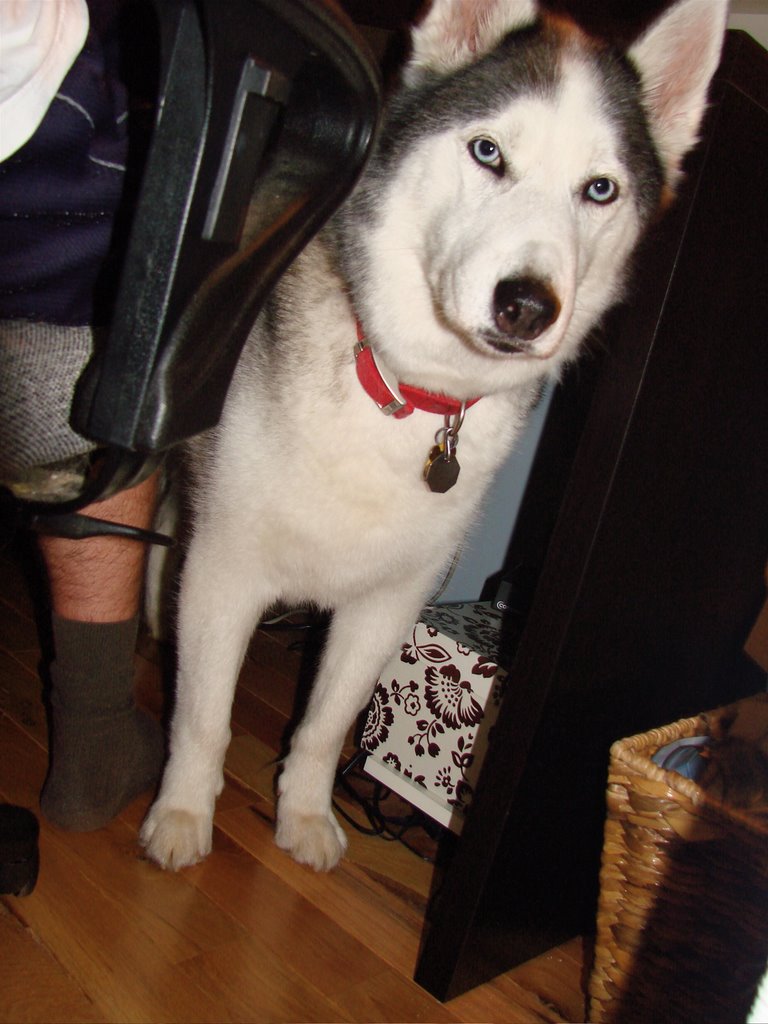
Instead, we today celebrate the birth of Mr. Finch, the perfect embodiment of the old cliché about dogs and men. While he’s not intensely loyal like a Lab or protective like a German Shepard, his intelligence, personality, sensitivity and wit (yes, wit) more than make up for his lack of subservience. Also, he’s freaking adorable.

As a baby:

And today, waiting for the blogging to end.


Although he strangely wanted one of these for his birthday, a new squeaky toy, a whole slice of cheese and a hiking/swimming trip tomorrow will have to suffice.

Anyway, enough about the Husky. Here’s a quick Round Up to keep you occupied until Sunday.

The action-packed primary battle for the Republican nominations in District 9 is profiled in this piece. For those who don’t know, there are two seats in this almost-guaranteed-Republican district and the current incumbents, Gail Bates and Warren Miller, are running as a slate and are being opposed by Melissa Ridgely Covolesky, a relative newcomer to the political scene.

The whole story is worth a read, but I want to highlight just one piece of it.

"I don't have anything personally against Melissa," [Senator Allan] Kittleman said. "She just came out of nowhere. In a Republican primary, people are going to want to see what you have done for the party and the community. She's a very nice person. She should have run for the central committee."

This mindset is, put simply, stupid. The idea that you need to pay your dues to a party before you can run for office is a horrible way of finding the best person for the job. The most loyal, perhaps, but is that what we really need? More politicians who are loyal to their party above all?

Needless to say, party loyalists agree with Kittleman.

For purely superficial reasons, I’d vote (if I could) for Covolesky. I mean, her birthday’s the day after mine, she has a Siberian Husky, and she likes chestnut trees, a trifecta!

The managed deer hunts taking place on public land in Howard County are expanding. Why?

The deer population at these parks has exceeded the ideal capacity of 15 deer per square mile, Norman said. In a survey of the land last winter, officials found an average of 75 deer per square mile.
Wowser, and you thought the county was crowded for people. Imagine being a deer.

It sounds like the first meeting of the BRAC task force was largely about the committee and the process. Which is good – I didn’t miss much.

I’m heartened to see in this article that the chair of the task force is emphasizing citizen involvement. I’m also a little surprised to read this:
Donna Thewes, a candidate for County Council seat in District 3 who attended the meeting, said the county should be aggressively courting businesses that may relocate to support Fort Meade.

“We are in a prime location,” she said. “The question really should be, what are we doing on the commercial end.”
Politicians and others seem to think that commercial developments are unmitigated goods: tax returns from them greatly outweigh tax expenditures. But this is a false supposition. Commercial and residential development cannot be separated. One without the other leads to all sorts of problems, just as too much overall development does, as well.

Moreover, many of the problems of growth in general – traffic, taxed infrastructure – are found regardless of whether you’re building homes or offices. To see a politician at this time ostensibly supporting more aggressive growth is, well, a little jarring.

That’s all for now!

Thursday, August 24, 2006

About that poll...

The poll at right will be closing on Sunday. So get your votes in now.

Interestingly, my plea for more Democrats seems to have backfired, as the gap between them and Republicans has only widened. Which raises the question: what do Republicans get out of a blog written a tree-hugging, granola-eating, peace-loving, tax-and-spend liberal? If the answer is something along the lines of "to see what the opposition is saying," then why read Republican-written blogs?

Most of the blogs and opinion pieces I read are by conservatives; I tend to learn more from them than I do from liberal writers, and on top of that, I don't really understand the impulse to seek continued affirmation of one's beliefs, which seems to be the case in much of the blogosphere.

Living large...

Even though I support the idea of this project, I’m not sure how well it will work in practice.

On a quiet, tree-lined street in the village of Oakland Mills sits a three-bedroom house, with 1 1/2 baths, a two-story living room with fireplace and a recently remodeled kitchen. The house is within walking distance of Stevens Forest Elementary School. At $339,000, it is advertised as the ideal starter home in Columbia.

The Oakland Mills Community Association and the Howard County Housing Commission bought the house in May for $287,000 and added $20,000 in renovations. The goal, however, is not to turn a quick $32,000 profit, much of which would be eaten by fees and closing costs. The stakes are much higher -- the house is part of a wager, by Oakland Mills, on the future of one of Columbia's oldest neighborhoods.

The renovation is part of Oakland Mills' multi-year revitalization effort, designed to spark interest in the 30-year-old Columbia neighborhood.

"Old does not mean bad -- old means opportunity," said Bill McCormack, chair of the Oakland Mills Housing Committee. "You can take a house and make it look new for an affordable price."
Is it really affordable? I suppose it is to some – namely, those earning more than median income, a group that I would guess has a near-saturated homeownership rate as it is.

Although it isn’t too far out of reach for them, a families making median income or less (roughly mid-80s) probably wouldn’t be able to afford this house unless they have enough cash just sitting around for a big down payment, which is pretty unlikely if they’re first time buyers -- the target group.

Not surprisingly, given the price, interest in the house hasn’t been high.
Whether buyers can be persuaded is unclear. Michelle Lewis, who works at the Elkridge office of Fairfax Realty and is the agent for the house, says buyer traffic has been slow and many people are turned off by a house with fewer than two full baths.

"Everyone complains Howard County is expensive, but a lot of first-time buyers get approved for a small mortgage and say, 'We want at minimum three bedrooms, two full baths and a garage,' " Lewis said.
This regrettable sentiment speaks to the fact that we, as a nation, are probably over-housed at this point. Over the last 50 years, as average family size has dwindled, the average size of our houses has grown considerably – from less than 1,000 square feet in 1950 to over 2,000 square feet today. While this change was driven in larger part by consumer preferences and our preponderance of “stuff” (computers, big TVs, ginormous Pottery Barn couches), zoning regulations mandating growing minimum square footage are also to blame. And, of course, there’s the fact that mortgages up to $1.1 million are tax deductible.

How much space do we really need to be comfortable? I know in America it is taboo talk about cutting back on consumption, but it might not be a bad idea to consider going smaller. After all, less space has its benefits: less to clean!

By the way, here’s a link to the listing of the house in Oakland Mills.

Wednesday, August 23, 2006

No BRAC meeting for me...

As you can see by the time stamps on the posts below, I didn't make it to the BRAC meeting tonight. But if you did, I'd love to hear about it in comments.

I'll spare you tales of moutain biking, which are even less interesting than fishing stories (uh, I really shredded that trail, man...).