Tuesday, October 31, 2006

You are what you read...

Since my County Executive prediction post just ain't getting done today, I'll answer the call of Jim Adams, who asked me what I like to read. But instead of making it just about me, let's all take a minute to share in comments what's on our nightstand or bookmarks folder.

Books:

Unfortunately, as I'm sure is the case with most of us, I don't read as many as I'd like. Generally, I'm a fan of books on history, social science, religion, fiction and some memoirs. The books I'm currently reading are:

  1. The Conservative Soul by Andrew Sullivan.
  2. The Geography of Opportunity by Xavier N. De Souza Briggs and William Julius Wilson.
  3. Alexander Hamilton by Ron Chernow (200 pages down, only 500 to go!).
The five most recent books I've read are:
  1. Chuck Klosterman IV by Chuck Klosterman.
  2. This Land by Anthny Flint.
  3. Under the Banner of Heaven by Jon Krakauer.
  4. State of Fear by Michael Crichton.
  5. The Consequences of Growing Up Poor by Greg J. Duncan and Jeanne Brooks-Gunn.
Trying to pin down favorite books is impossible for me, but if I had to choose a couple, I'd go with:
  1. Silent Spring by Rachel Carson.
  2. The Corner by David Simon and Edward Burns (the guys who created The Wire).
  3. And, for some fiction, The Monkey Wrench Gang by Edward Abbey, which is the source of the Hayduke name.
Magazines and blogs:

Most of my reading time is spent with blogs and magazines. Of the magazines, my regular reads are:
  1. The Economist
  2. The New Republic
  3. Reason
  4. And, less so, The American Prospect
Blogs basically rule my reading habits now, and here are those that I read daily (this is the only list that's actually ranked in order).
  1. Andrew Sullivan -- a principled conservative
  2. Matthew Yglesias -- a principled, but pragmatic, young liberal
  3. Reason: Hit and Run -- ah, libertarians
  4. Marginal Revolution -- two economists talk economics
  5. Mac Rumors -- source of all the latest dirt future products from Apple
  6. Deadspin -- snarky sports commentary
That's it for me. What about you?

So, the senior tax cut...

Between Bill Santos's post from last month and the comments in today's post on David Keelan's blog, pretty much all that needs to be said about this bill has been said.

Just to reiterate: The tax cut itself doesn't bother me as much as the justification -- specifically, the one claiming that young families cost the county too much and are therefore less desirable as residents, something I read in this article and heard from Chris Merdon at a candidates forum on Sunday.

It's all your fault...

The blame for growth and all its attendant problems is shared among many: developers, politicians, too trusting homeowners association representatives, and, now, George Bush.

Yes, that’s right, something else is Bush’s fault.

As they battle sprawl, Washington area leaders say they face a stubborn foe, and it's not greedy developers or the tyranny of the automobile or the desire for big houses. It is the United States government.

In scattering employees to the region's outer edges, local officials and planners say, the federal government has undermined efforts to concentrate growth near public transit and the area's urban core -- the strategy local officials see as key to reducing traffic and conserving resources in a booming region.
“But, wait,” heartened Bush supporters will say, “it’s probably the ‘federal bureaucracy’s’ fault that federal offices are contributing to sprawl, over-development and loss of natural areas.”

Which may be true, but as I was reminded recently, the buck has to stop somewhere, and in government, it’s at the top. 

The move is reminiscent of another, far bigger dispersal: the Pentagon's transfer of 30,000 military and civilian employees from Arlington County, the District and other close-in locations to installations farther out, mostly to Fort Belvoir in southern Fairfax. Rather than being near Metro, the jobs, which will be followed by thousands of related contractors, will be in an area with crowded roads and little transit. Also getting thousands more workers are two other posts on the region's fringe, Fort Meade in Anne Arundel County and Quantico Marine Base in Prince William.

…Other regions also must contend with the consequences of military relocations and other federal actions, but the dominance of the federal government in Washington makes the area uniquely dependent on it. Ideally, officials say, this could be a plus, if the government used its sway to drive unified planning across a region divided among three jurisdictions.

That happened to some extent in the 1990s, planners and officials say, when President Bill Clinton issued an executive order that federal agencies try to locate within downtowns. By dispersing agencies outward, critics say, the federal government is effectively undermining its $10 billion investment in Metro.

"Six or eight years ago, [the federal government] was moving in the right direction . . . but now you have a couple major decisions that undo" past successes, Arlington County Board member Jay Fisette (D) said.
So, under Clinton (a.k.a., the good old days) the federal government endorsed a smart growth approach for the siting of its facilities, while now, under Bush, the policy is one that exacerbates sprawl.

Now, I’m of course being a little silly with this (and both Democrats and Republicans are my intended targets). But the relevant point, that federal government has significant impacts on our settlement and growth patterns (especially in Maryland), is important and underappreciated. I’ve talked a lot in the past about “external” growth pressures that we have almost no control over, and this is one of them. Although few votes for President will ever be decided because of a candidate’s position on federal agency relocations, we should not discount the profound effects of federal priorities on local matters.

Thanks to my pops -- who works in a suburban federal building (that he walks to!) -- for sending along the article.

Monday, October 30, 2006

Conjecturing analysis...

A hoped for longer post will have to wait as we put on our Analysis Hat and look at some local races. Because blogs are the bastion of baseless speculation, let's speculate -- as objectively as we can -- on the outcomes of the local council elections, which, in case you haven't heard, are happening next week. (Don't forget to vote!)

Despite what we'd like to believe, the growing cabal of local blogs probably aren't the best barometer of the feelings and discussions of the general, non-blogging public. Even on our best days, we reach only a tiny percentage of likely voters, and even factoring in the personal connections of our regular readers, most county residents (regrettably) have never heard of yours truly.

Feel free to challenge that assertion -- I'd certainly like to think the Hayduke Sphere of Influence is expansive.

With that in mind -- challenges notwithstanding -- I think most voters interact with local issues and campaigns in a very limited sense. They may read the endorsements of newspapers. They may see a few commercials. They might see some signs on their neighbors' yards. But on the whole, they have a limited understanding of the candidates and their issues, which makes prognostication difficult, especially for those of us who are highly entrenched in matters of local interest and who are, frankly, pretty biased.

Also, there's the matter of how local elections are impacted by state and national races. With the decline in Republican popularity over the last year, what impact will that have on the local races? In my uninformed voting days, I would go down the list checking everyone with a "D" next to their name? How many voters will do that this year?

Without any local public polling data, it's tough to read these elections. But let's try anyway.

Here's a hasty, poorly-thought-out analysis of the various council races.

District 1: Courtney Watson wins comfortably (10 points). As Chris Merdon is wont to point out, the district still leans Democratic, and Watson, with several years experience on the Board of Education, a well-known family and a moderate stance on most issues is poised to be the first Democrat to represent the county's northeastern section in 16 years. In a county where education is the most important issue for most voters, a former board chair who served without controversy in a non-controversial time is almost impossible to beat.

District 2: Calvin Ball, without question (15 - 20 points). Despite not gaining the endorsement of a couple newspapers, there is no way I'm giving this district, the most Democratic in the county, to a Republican. That's just how we roll.

District 3: Toss up. This is the only race in which I'm not confident in picking a winner. Jen Terrasa and Donna Thewes are both qualified, active and fairly well-known in their respective communities. In Terrasa's favor is the fact that she lives in and served on the village board for Kings Contrivance, which is most likely the swing area in this District (with Owen Brown being predominately Democratic and Savage/North Laurel predominantly Republican). In Thewes' favor are the facts that she's edged herself to the middle and she's, apparently, been everywhere during her campaign. I'm told there wasn't an event during the last six months that she didn't attend. If I have to choose (and I do), I'll fall back on bias and choose Terrasa by 3 points.

District 4: Mary Kay Sigaty, again without question (12 - 15 points). See description for District 2 and also Courtney Watson (BOE experience). Although not as solidly Democratic, it still leans far enough to the left that any Republican who wants to win is going to have to be a stellar candidate. And while I've been surprised by Tom D'Asto's pluckiness and commitment, I don't think he's done enough to pull this one out. He has gone after the Town Center Master Plan, playing up fears of massive city-fication -- which was a wise move -- but I think Sigaty's insulated enough from the process that many voters who view this as the main issue won't be swayed.

District 5: Greg Fox, hands down (15 - 20 points). See Districts 2 and 4 for explanation. As refreshing as it would be to see Don Dunn as a councilman, the hill he must climb is just too tall.

So, what do you think? Am I being blatantly partisan, or have I managed to sufficiently suppress my bias and provide a reasoned analysis?

How about we turn this into a contest? Post your predictions (with a margin of victory) in the comments and whoever gets the most right gets a prize of no financial value and to be determined at a later date. (Feel free to post prize ideas, too.)

I'll have a County Executive analysis later this week, but for the sake of the contest, please include your predictions here (or not).

Please be sure to use an identifier. Note that you don't have to divulge any personal information (and I won't divulge any, either). Just click the button that says "Other" and fill in a random name of your choosing.

Sunday, October 29, 2006

Elections?

I'm guessing that most voters don't really start following local races until a week or so before the election. I make this guess based on very little evidence -- really, just my experiences from past elections, conversations I've had recently, and the fact that the Sun today (nine days before the election) ran several summary pieces about key races.

Notably, growth and the race for County Executive. If you have time to read only one story about the candidates, this one's probably your best bet.

Also, there's the senate race for District 13 and the recent birth control mailers that have caused quite a stir (among those who follow these things closely, see above).

Aside from summary pieces, the press also likes to write about the underdogs hoping to sneak in because of some external circumstantial change in their district, like "demographics."

Finally, though I don't want to encroach on the turf of our local education blogger, here's a story about the Board of Education race and how the candidates feel about redistricting.

With that out of the way, the only other item I want to highlight before going out for Leaf Raking 2.0 is a great letter to the editor from local planning sage Robert Tennenbaum.

For years, Columbia residents have complained about Town Center. It's not complete, it's not good for pedestrians, there are few attractions or cultural amenities. Every new construction project was a surprise as residents were kept in the dark about future development. While residents must submit home improvements for architectural review, there is no professional design review for commercial projects in downtown. The complaints go on and on.

Things had to change. Downtown needed a master plan. Ultimately, the county agreed to fund a first-ever community planning process called a charrette. A consultant developed a concept to illustrate what was interpreted were the results of the charrette. The outcome of the charrette was not a master plan, it was a concept. A focus group of residents was created to meet with and advise the highly professional Department of Planning and Zoning staff to further refine the concept and help draft a master plan. The planning staff responded to all focus group comments and concerns. Without serious deliberation, the focus group decided not to reach consensus. This left the focus group efforts and the planning staff's work swinging in the breeze.

I believe we are on the edge of destroying the entire one-year effort of creative hard work. I also believe this is because many involved residents either have not fully read or do not understand what is in the proposed draft of the downtown master plan. The planning staff assembled a good and comprehensive draft downtown master plan. Does it need to be tweaked in places? Yes. Do we need a better traffic study? Yes. Most importantly, does it respond to residents' complaints about downtown and propose a more complete, active, vibrant, pedestrian-friendly and beautiful mixed-use Columbia downtown and more? Yes. Does it fulfill what my former boss, Jim Rouse, would have supported? I believe yes.

There comes a time when we all must come together, agree that we cannot satisfy everyone (especially in Columbia) and look at the big picture. If we cannot do this, the planning effort will die. What a terrible message that sends to the world about Columbia, the model city. Let the process move forward.
That's all for today. Blogging will be back to normal -- which is to say, in Full Force -- this week, as we slouch towards Election Day.

Thursday, October 26, 2006

Random funniness

Guy at the market where I stopped for some grub, obviously recognizing I'm not from around here: "So, why are you in town?"

Me: "I'm here for work."

Market Guy: "Oh, are you a Scientologist?"

Me: "Uh, no. Why?"

Market Guy: "You're wearing the uniform."

My outfit: Blue button down shirt and black slacks.

Strange place.

Wanting more...

So, like yesterday, I'm still wanting for inspiration. I can't decide if it's because I'm in this strange place or because I'm ready for this whole election thing to just be over.

Anyway, as of press time, Patuxent Publishing hasn't released its endorsements. Since I probably won't be back on until much later today, check out the other blogs for the latest news.

Aside from that, I don't have much. Sure there are a few stories in the Examiner and Sun that I could write about, but I'd be stepping on others' toes (or straining to write contrarian rebuttals). Wordbones, however, has an interesting post about changes to downtown...Ellicott City.

I do want to say that I strongly disagree with David Keelan's decision to expose the true identity of a commenter he doesn't like, and one with whom I disagree (and am frustrated by) regularly. Regardless of how you feel about her, David's decision sets an ugly precedent. Commenters can be held to different standards depending on their views and the threat of tracing identities through IP address (which are available for all to see by looking at the Site Meter reports -- see bottom of the page) looms over all. Such things help stifle diverse debate and might prevent many worthy commenters from participating.

Wednesday, October 25, 2006

Wanting...

Is southern California -- home to the music, movie and television industries -- supposed to be a inspirational place? Or am I confusing correlation with causality?

I think it's the latter, though perhaps I'm just jet-lagged.

Regardless, after waking up ridiculously earlier this morning (Pacific Time), walking around the downtown Hollywood area for a couple hours and enjoying a Strawberry-Banana Soy Protein smoothie with a shot of Wheat Grass on the side (condensed veggie nutrients, yum), I still can't think of anything I really want to write about.

Which is unfortunate, because, as my wife joked yesterday, without the obligations of home, I have all the time in the world to blog. But nothing to blog about.

Ah, the sorrow of excess. I guess I now know how it feels to be rich but unsatisfied.

Anyway, since my big ol' Whoop De Doo begins in a couple hours and runs until 10 pm, by which time I'll be exhausted (must resist adjusting to new time zone), this is probably my only time to write today.

So, here are a few stories you might have read with a few comments you might not care to read...

A friend sent a long the link to this one, basically a tit-for-tat piece about the race for Governor. In addition to trying to convince me to load up a bright red Caddy convertible and drive through the desert to meet him in Vegas this weekend to both loathe and fear, he asked me about public transportation -- specifically the benefits of bus rapid transit (basically, separate lanes for buses) as compared to rail lines. Although I haven't given the subject the thought it deserves, I will say that transportation systems that tie us down to a specific means and configuration (i.e. rail) might not be the best approach for the future, simply given rapidly changing technology and a soceity that's following suit. The problem, however, which my friend gets at, is perception about buses. While bus transit is cheaper, easier to reconfigure and (maybe) more efficient, a lot of people don't like them, for various reasons.

That said, fixed line transit has a place, I think. Also, one could probably come up with a good metaphor about rail systems/bureaucracy and bus lines/decentralization, but I'm in no mood for metaphors today.

---------------

Best Headline of Today: "County candidates appear to differ little." You wouldn't get that impression if you only read the local blogs, however. Such is our purpose: to inflate minor differences to the point of absurdity. And really, what's the most minor of them all? Democrat vs. Republican.

---------------

More political stuff: Schrader-Robey, getting testy; Democrats endorsing Merdon; and More Schrader-Robey.

I suppose I should say something about these stories, but I don't really have much to add. Others, however, are full of thoughts. See, for instance: David Keelan and Wordbones, who disagree about both the importance of these endorsements and the motivations behind them.

In more endorsement news, the liberal media have really been living up to their name this election cycle, no? At what point do laughable allegations of bias and attempts at victimization become sad instead of just funny? Are we there yet? I think in this instance Sandy from the play/movie Grease is a good metaphor for Republicans, with the media being the greasers (Burger Palace Boys and Pink Ladies). I won't elaborate, however, because, as I said, I'm in no mood for metaphors. Suffice to say, the message in Grease -- fitting in is more important than keeping it real -- is what kept my high school drama teacher (What's up, Mary Jane!) from producing this much-loved if morally bankrupt musical.

Will Patuxent Publishing follow it's fellow liberal institutions and endorse mostly Republicans? Tune in tomorrow to find out!

Monday, October 23, 2006

Monday Round Up...

Just a couple quick stories and a challenge today...

First, congratulations go out to Howard County, which today earned the distinction of having the (subjectively) worst intersection in the Baltimore area. Winning yet another award for us was the Route 32 East to I-95 North ramp, a left-lane to left-lane doozie (it's funny that there's no mention of the Rt 32 West to I-95 South ramp, which has almost the same design but a different gradient).

Having spent much of my life in the King's Contrivance area, I have a special place in my heart for this interchange. It's really not that bad, as long as you stomp the gas pedal to the floor when going up the hill.

------------------

Since posting about this story always seems to drive up the hit count, here's a new installment about Howard's Madame Female Companion in Residence, Brandy Britton. Is it just me, or is the reporter -- former Flier scribe Luke Broadwater -- a little too involved with the story? Not in a money-changing-hands way, but in a Hunter Thompson, writer-centric way.

Maybe it's just me.

Regardless, the story has more than you probably ever wanted to know about Dr. Britton, including her measurements, contents of a text message, and what she's wearing -- "black knee-length high-heeled boots and a short black skirt" -- during the interview.

A related story raises the question of whether it's "worth" expending limited police resources to chase down practitioners (and customers) of the world's oldest profession.

Taken together, these two stories paint an interesting portrait of the Examiner's ideology. One favorably personalizes Britton and the other seems mildly in favor of relaxing vice enforcement. Perhaps something similar to the Association of Libertarian Feminists (ALF, a real organization!). Britton, it should be noted, is a former women's studies professor at The Best University in Baltimore County, UMBC.

------------------

Finally, a challenge.

Shortly after An Inconvenient Truth came out, a popular listserve in this county was full of questions about how we can make individual changes in our lives to reduce carbon emissions. There seemed to be a lot of energy and interest in this topic, which is an encouraging sign.

Sustainability starts with individuals and the ability to change our actions. We can hope and work for change on a larger scale, but ultimately, we can only change what we control -- our own tiny slice of the world. I don't mean to discount the efforts of those who advocate for big changes, but a better way of accomplishing these ends, in my opinion, is by starting at the lowest level and working our way up from there. A million micro changes are just as effective -- an infinitely easier to accomplish -- than a single macro change. Which is why I was heartened to see such interest on the listserve.

Anyway, recognizing the power of aggregated individual actions, the on-line magazine Slate is soliciting readers to participate in an eight-week carbon diet.

Americans are the climate's worst enemy. On average, each of us is responsible for about 22 tons of carbon-dioxide emissions every year, according to the United Nations, compared with an average of six tons per person throughout the rest of the world. That means the typical U.S citizen emits the equivalent of four cars.

Much of the discussion around climate change involves national and international policy—should the United States sign the Kyoto Treaty or increase auto efficiency standards? But even without major political or legislative changes, there's a lot that concerned individuals can do to make the problem better. To that end, we've created the Slate Green Challenge—a straightforward program to evaluate and reduce your carbon emissions between now and the end of the year.

What they don't say but should is that individual actions, collectivised over a large segment of the population, make enacting and enforcing national and international policy much easier. But I digress.
For the next eight weeks, Slate, in collaboration with eco-Web site treehugger, invites you to consider your own individual contribution to global warming—and challenges you to go on a carbon diet. The goal is to reduce the amount of CO2 that you put into the atmosphere by 20 percent.
Here's where you sign up and take your initial quiz. Here's a link to the first segment, which talks about transportation.

Also, if you're interested, go check out the Earth Day Footprint Quiz, which analyzes your lifestyle with a serious of questions and spits out the number of acres required to support your existence. Perhaps its most striking feature is on the final page where it shows you how many Earths we would need if the world's population lived like you. Feel free to leave your footprint in the comments.

Me, I'm 13 acres and three planets.

Sunday, October 22, 2006

Knowledge is power!

So, it's not gorgeous, but how about the new layout? What began as a fairly minor request for a "Recent Comments" box morphed into an all-day Html-athon.

In addition to the recent comments feed, I've added (supposedly) live feeds from several local blogs on the left sidebar. The top link will take you directly to the blog's front page, and the link underneath is pointed to the most recent post. Unfortunately, the recent comments feed does not seem to be updating very quickly, and I'm worried we may encounter the same problem with the blog feeds. Let me know if they update for you.

I also added a link to the blog of Ian Danger, a local UMBC (Go Retrievers!) student who's been writing more about local politics as the elections approach.

Finally, because I want to leave you with something of substance, the Voices of Visions forum. The Baltimore Sun's story about the lecture -- with the understated headline, "Columbia: 'Grow or Die'" -- is well worth a read. Vernon D. Swaback, the night's speaker, had some pretty strong and, I would imagine, controversial things to say, such as:

Opposition to greater height and density is often pervasive on elected and appointed officials, he said, but the result isn't always good, he said.

"You preclude the worst, you preclude the best and you just lavish the attention on all of the mediocrity that you can get," Swaback said in the interview. "Public protests and codes and ordinances can do a pretty good job of keeping bad stuff from happening. But they also can keep good stuff from happening."
And:
"There are certain things that we absolutely know are happening," he said in the interview. "We know that the Earth is adding 200,000 people net every day. We know that we're building the equivalent of something like 50 cities of a million people every year. We know that globalization is changing how we think about supremacies, goods and services, each other. ... And we are really threatening the ability of the planet to sustain life. We've been playing fast and loose ... and this whole movement right now of smart growth, green architecture, sustainable design is like a revolution in values. The words might end up being a fad, but the direction won't."

There is another reason for downtown Columbia to change, he said: "Grow or die."

"That doesn't mean if you have 100,000 residents today that you must have 200,000 next year," he added. "It simply means it stays alive. It stays healthy. And to stay healthy, it must change."
The next Voices forum is scheduled for November 16 and will feature Ann Forsyth, a professor from the University of Minnesota. The full schedule of forums is available here.

Thursday, October 19, 2006

Ducking responsibility...


The Absent October continues unabated, with the Hayduke family leaving now for a short sojourn to the Delaware Flatlands, not quite the shore, where the likely topic of discussion among The Gathered Few will be babies, both born and yet-to-be. Which is fine, if a little uncomfortable. (whoops, too personal.)

In other travel news, I'll be in Hollywood all next week, conferencing with over a thousand people who care more about affordable housing than most folks. Unlike this weekend, however, I'll still be watching and writing about what goes on here in Howard-wood. So, don't get any ideas.

As for right now, I've got a few things to share. If these items or the picture above leave you wanting for inspiration, catch up on some ongoing discussions about The Website That Shall Not Be Named and Affordable Housing/Young Slackers. In related news, it's good to have Mary Smith back in the fold; she is easily the most enigmatic commenter to ever put finger to keyboard in Howard County.

Now, then, on to the Soy-Based Protein of the post...

Although I sympathize with their situation, I think residents are unfairly targeting the Lincoln Tech students in this story. Since anecdotes and generalizations seem apropos, here are mine: I used to live very close to the Hopewell Park a couple years ago, a time in my life when free time was fairly abundant (read: graduate school). Many warm spring and fall afternoons were spent playing basketball with these guys, and the only illegal things I ever saw were rough fouls and traveling.

--------------------

Bucking convention, I agree with this Flier editorial supporting "planning in small bites," something that was proposed and lambasted several months ago by Democrats on the county council. It's also kind of similar to my idea about creating shorter-term plans for Town Center to implement the 30-year vision. The debate over Town Center has spent considerable time talking about scale and what is or is not "human scale." Making plans smaller, whether spatially or temporally, serves to concentrate our efforts at a level that is both more tangible and more workable.

--------------------

Finally, for those of you who made it to the General Growth forum tonight, please share your thoughts on the speaker (and the event in general) in comments.

Wednesday, October 18, 2006

The well is dry...

Although I have plenty I want to say, I can't figure out exactly how to say anything. Most of my free time today was spent trying to contribute to a discussion on the Howard County Citizens Association email list, but for all my efforts, the best I could muster were a few poorly-crafted emails that never left the draft folder.

I think I was trying to be too philosophical about the issue -- affordable housing -- which is a fairly common problem I have and something I've been criticized for in the past. I can't help it though. It's genetic...just ask my father.

Anyway, use this post as a thread to talk about what you want. But, please, keep it abstract.

Tuesday, October 17, 2006

Planning pitfalls...

After praising them yesterday, I’m afraid I’m going to say some things members of the new Coalition for Columbia’s Downtown aren’t going to like. First, the good:

“There’s nothing for low-income housing” in the county’s plan for redeveloping downtown Columbia, said Alan Klein, head of the newly formed Coalition for Columbia’s Downtown.

…The Department of Planning and Zoning proposed setting aside 10 percent of units for moderate-income housing and 5 percent for middle-income units, according to the draft plan. Klein said that accounts for those making $50,000 to $100,000 a year and overlooks those who make less.

The group proposed setting aside at least 20 percent of all units for moderate- and low-income housing.

“We simply will not accept the fact that its impossible to have low-income housing in Columbia,” said Del. Liz Bobo, D-District 12B, who spoke at the group’s gathering Monday in Columbia.

Yes, yes, yes. It is not impossible to have housing for those making less than $50,000 a year. In fact, it is essential, despite despicable characterizations to the contrary.

The idea of a jobs-housing balance is one that has gained considerable steam over the past couple years, and it calls for, essentially, a housing stock that is tailored to the income profile of our workforce.

Philosophicaly, the foundation of the concept is that everyone should be able to live near where they work. Pragmatically, reducing the distance between home and work offers many benefits for residents and the community at large – namely, lower traffic volume, increased viability of local transit, decreased pollution, more quality time with families, stronger civic connections, and more.

So, we pretty much agree that affordable housing is a desireable in downtown Columbia. But here’s where we part ways: “The group also advocates fewer residential units to be built downtown — 1,600 rather than the planned 5,500…”

No, no, no. If affordable housing is really such an overriding concern, calling for a 780-unit reduction in the potential number of affordable units doesn’t seem like the best decision. Under their ideal scenario, Town Center would produce over the course of 30 years 320 affordable units, less than 11 each year. Which hardly seems worth it considering the county is faced with an almost 30,000 unit shortage of affordable housing.

I’m not suggesting that Town Center is the panacea for our affordable housing situation, but it is an area with significant development potential where real progress could be made -- and not just on affordable housing, but on many of our other deficiencies (lack of decent transit, cultural amenities, small businesses, etc.).

Because of the vast potential we have in Town Center, I’m hesitant to support proposals that tie its legs before it's had a chance to get out of the gate.

Rather than focus on the numbers -- which as I clumsily said in the past are just abstractions at this point -- we should focus on the equation for the numbers.

Trying to plan in detail the next 30 years of development for Town Center is full of pitfalls, not to mention the fact that such an exercise completely devalues the preferences of future Columbians. Instead of deciding on every last detail now, we should focus on the short term specifics and keep the long term discussion focused on guiding principles.

The real-world manifestation of this idea is to create a visionary, overarching 30-year plan and develop a series of shorter-term, detailed oriented plans with, say, five- or ten-year time frames to implement this vision.

These shorter plans can house our limits, or, in my preferred scenario, they would include incentives and benchmarks to gauge our progress in meeting the longer-term goals -- like affordable housing, environmental quality, transit and infrastructure improvements. So, instead of prescribing the exact number of units to be built within each period, the plans could create a framework where the intensity of development is linked (within a reasonable extent) to the quality of development and the quality of amenities we receive. To make it fair for everyone, these incentives and benchmarks must carry the force of law.

Reward good behavior and good development with more density. Punish failure to meet stated benchmarks with density reductions. In short, create a market for quality development that actually captures the externalities -- both good and bad -- of growth and ascribes financial value to that which previously lacked it.

Monday, October 16, 2006

Bad news...

Apparently, The Wire is taking this week off (because of On Demand, I usually watch episodes the Monday before their air date, which is when they become available). Episode #44 -- "Unto Others" -- will not be shown on regular HBO until Sunday, October 29, meaning it'll be On Demand next week. For those of you as obsessed with the show as me, my pain is surely understandable, but if you're interested in the smartest Wire talk around, check out Heaven and Here. They just posted an interview with David Simon, who made his presence known in the site's comments section a few weeks ago.

Monday Round Up...

The people have spoken, and I have heard them loud and clear: “Hayduke, you’re not funny.” OK, I get it. Please forget my failed attempt at humor ever happened and allow me to move on whilst some dignity remains.

-----------

In other bloggy news, it seems like everyday I find another new local blog. The latest two: Fine Line and A Tale of Two Cities, which has posted a great piece about the WWJRD (What Would James Rouse Do) phenomenon. Go check them out!

------------

Meanwhile, in newsy news, candidates for various offices (County Executive and Council) are biting their tongues about solutions to the affordable housing situation. Someone told me a while back that affordable housing would never be a campaign issue -- for reasons that are fairly self-evident. Undaunted, People Acting Together in Howard are working to get it on the radar screen and in the hearts of voters. Unfortunately (or fortunately for some), the final report of a county task force examining the issue is due on Halloween, which effectively neutralizes the limited pressure on candidates by allowing them to prudently suggest that proposals from a panel of experts should dictate future policy. This task force is far better equipped to address the issue than any campaign.

Now, how the candidates react in the week between the panel's report and the election might be of some value to voters, but by that point most minds will have been made up.

-------------

I went to the press conference today of the group of citizens committed to preserving the initial vision of the charrette. I got there late, so I missed most of it (damn all-day training at work!). But I did get to see all sorts of politicians jockey for position around the Hug statue. Also, there were several non-political people there that indicated this group has only good intentions. Criticisms of the charrette process have been a mixture of honest questions about the plan for future of our community and NIMBYism, and I was glad to see folks from the former camp rather than from the latter. It's important to remember, however, that with respect to downtown, we all want the same thing: a place we can be proud of. If only it were as easy to agree on the means.

-----------

Speaking of the future of Town Center, General Growth and Howard Community College are sponsoring a series of four monthly forums titled "Voices of Vision." The first is on Thursday, October 19 at 7 pm at the Smith Theater. The speaker will be Vernon D. Swaback, one of Frank Lloyd Wright's former apprentices. RSVP is requested at 877.311.2944 or rsvp@generalgrowth.com.

------------

Finally, The Website That Shall Not Be Named. This has caused quite a stir on other websites, which is not unexpected. I'm disheartened to see so much emphasis being placed on the source of the site and whether it's negative and not the information contained within it. I don't want to get into a discussion of the details -- I think the site speaks for itself -- but this idea that Ken Ulman has "gone negative" in an act of "desperation" strikes me as completely lacking in merit. The tone of this election was set a long time ago, and to suggest now that he's the one responsible for dragging it into the gutter is disingenuous at best and completely dishonest at worst.

I've managed to bite my tongue several times with respect to unfair attacks on Ulman and on others who dare to express support for him. There have been unsubstantiated allegations and purposeful misrepresentations about his youth, his family, his votes, and his objectivity; most recently, he was flat-out called a "coward" in a blog post that was removed sometime between 3 pm and 6 pm today.

Similar statements have been made about his supporters as well. (There was one particularly egregious incident where a young woman who asked a question at a forum, deemed a "plant," was crudely connected to a potential riot arrest following a Maryland basketball game. The comment was later removed.) The mounting hostility and estrangement from the "issues" is largely what motivated me to move away from political blogging (my skin's only so thick and there's only so much one can take of being routinely called naive, a blind apologist, a hypocrite and more).

The internet, and by extension blogging, at its best is a place where information is easily accessed and connected. It provides immediate substantiation of one's arguments, with the supporting information only a click away. From what I've seen, the site in question has sourced the points it makes. To be sure, it is written from a partisan perspective and is clearly meant to impinge on the belief that Chris Merdon has a stellar voting record when it comes to growth. But that alone does not invalidate the conclusions it draws or the rigor of its sources.

On the flip-side, blogging and internet can be bastions of disparaging gossip, innuendo, ad hominem attacks, witch hunts, extremism and, worst, groupthink. Nobody wins when this is case. We are divided further and our dialogue screeches to a halt.

I'd like to echo the sentiments of at least one commenter: If there is a cogent, well-sourced refutation of the website, I (and many other voters) would love to see it. However, if the only response is to attack Ulman for negativity (something we all share responsbility for) and to claim it an act of desperation, this should be viewed as a tacit admission of the site's accuracy.

Friday, October 13, 2006

What a strange day...

I know, Friday the 13th and all, but being only mildly superstitious, I don’t put much stock into calendrical aberrations. That said, if you’re a member of the Knights Templar, I’d keep an eye out for minions of the King of France, just to be on the safe side. This is, after all, the 699th anniversary of the massive roundup of the band of warrior monks.

Obscure reference, to be sure. But as I said, it’s a strange day and I’m feeling spunky (see below).

Anyway, there are a few interesting stories in the papers today, such as…

Report notes housing crisis: We already talked about this, but now the task force examining the affordable housing situation in Howard County has received a draft version of the study they hope will bolster support for a more aggressive strategy. The study, at least according to the article, doesn’t really add to much to what I wrote in this post, but one thing it does include is an actual number for the shortage of middle- and moderate-income housing in Howard: roughly 27,000, which is a lot.

Curiously, the article includes this paragraph:

The rental market "is equally troubling," the interim report says. It notes that vacancy rates are exceedingly low and that the median monthly rent was $1,194 in 2004, the most recent year for which figures are available. It estimates that the median has since risen to $1,373.
Which is strange because according to the Census Bureau, median monthly rent in 2004 was $1,097 and in 2005 it was $1,109. Not sure what to make of that. Perhaps the study’s author “Richard Clinch, director of economic research at the University of Baltimore's Jacob Finance Institute” gathered his own data.

Regardless, the article is worth reading.

Va. workers not sold on living in Md., survey says: So, all those people whose jobs are moving as a result of BRAC might not become our neighbors after all. Well, that would certainly relieve some pressure from the housing situation. Still, the survey comes with a caveat: “In his presentation to the County Council, Dr. Samuel Seymour, a member of the BRAC task force, characterized the survey as "premature" and said it was conducted when workers were in a "state of denial" about the move.” The transfer is scheduled to occur in 2010.

Volunteer group cleans up stream: Thank You. Can you come do the stream by my house next?

More Resume Padding?

I'd like to take this time to bring something to your attention. Chris Merdon, councilman and candidate for county executive, is misrepresenting himself on his webpage and in forums throughout the county.

On his website, Merdon refers to himself as "Vice-President of Affiliated Computer Services (ACS), a Fortune 500 technology company."

Yet, when I look at the ACS website, I notice that he's not listed with the other vice presidents. And if I type "Chris Merdon" and "Vice President" in Google, I get a bunch of links but none to an official page of his employer that would substantiate his claim.

This is very concerning. I have exhausted all investigative possibilities, which leads me to believe that in fact he is not what he says he is. We cannot have a county executive who purposefully misrepresents his work experience in such a manner.

Update: It has come to my attention that Mr. Merdon is actually a regional vice president. Why can he not admit this? Why must he lay claim to full vice presidentship, when his powers only extend to the edges of an unspecified region?

I think this distinction is as important as that of "Assistant Regional Manager" and "Assistant to the Regional Manager."

I also here from a friend of my pizza delivery guy that Merdon is not a big fan of cats.

[/tongue in cheek]

Thursday, October 12, 2006

hOMe improvement...

The Oakland Mills Village Board has been buying and renovating older homes in hopes of luring "young professionals" to the village (as if the Mexican Coke wasn't enough). As I've said before, I generally like this program, but I can't help but pause when seeing the prices. The first home offered for sale was listed at $340,000, and the second home on the list cost $350,000 and they plan to spend $175,000 on renovations, pushing the likely listing price north of half a million dollars.

I'm a young professional, as are most of my friends. Although there are a few who make the kind of money that allows them to buy such houses, the majority of my peers (I think) are looking for houses priced considerably lower. Maybe my friends and I are just low rent.

I don't really want to belabor this point. I generally think OMVB is doing a good thing with this program, even if they could just let the market work on its own, allowing young professionals to buy these houses and renovate themselves. Also, I think they could seek grant funding or some other way to help subsidize the purchase price.

But I don't want to be a wet blanket.

Actually, the real reason I linked to this article is because of his quote from the county's housing director, Leonard Vaughan.

"Oakland Mills is one of the older villages," he added. "Some of the houses look like mobile homes. They are on great lots, but the houses were built to be affordable. People have done a great job in keeping them up. What we're trying to do is take it to the next level."
Hey, he's talking about my house. So what if it looks like a mobile home, anyway? What's wrong with that? What are you trying to say?

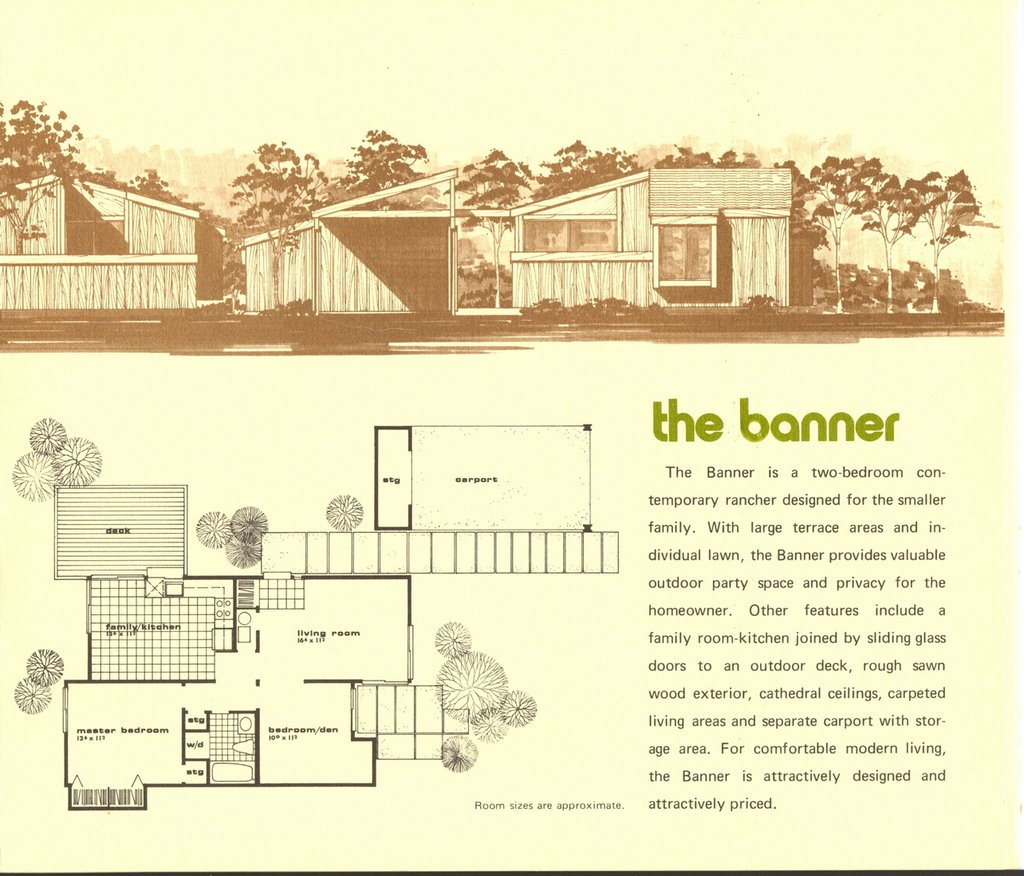
It's small, fun, affordable and way cooler than your house, Vaughan. See?


It was also featured in Better Homes and Gardens or Good Housekeeping or something like that in the early 1970s as an example of modern living. Can you say that about your house?

The Other Side of NIMBY...

I usually try to avoid commenting on letters to the editor in the Flier. It's a place where people should be able say what they want (within reason) without running the risk of having some annoying blogger parse their every sentence. What's more, in weeks like this, it's a hornet's nest of partisanship that I don't feel like kicking. Except…

…for this:

Vote for Democrats is vote for run-down downtown

On Oct. 4, the Baltimore Examiner ran a front-page story stating that 90 percent of the new residential units proposed under the new charrette master plan for downtown Columbia will be apartments. Some or most of these may be rented through government subsidy programs.

So much for the upscale luxury condominium image that was presented during the charrette process. Are we supposed to believe that Town Center is capable of absorbing 4,950 rental units without experiencing any of the problems associated with this type of housing program?

As every day goes by, this November's election is becoming more and more of a referendum on saving our very special and unique community versus turning it into an urban nightmare. We already have enough traffic, pollution, crime, drugs, gangs, etc.

Wake up, Columbia. Your choice should be very clear: Ken Ulman, who has orchestrated and endorsed the charrette master plan, and Mary Kay Sigaty, who wants more rental subsidies (see her Web site), or Chris Merdon and Tom D'Asto, who support affordable housing, but believe that planning and managing the growth of Columbia should be done in a responsible manner.

Nov. 7 will be our last opportunity to stop the charrette master plan from moving forward. Please do the right thing and help preserve the Columbia we know and love by electing officials that will listen to our concerns and act accordingly.

Mark Pennsy
Hickory Ridge
Honestly, I'm appalled by this letter, with its implicit prejudices, appeals to the basest fear instincts, and total ignorance of the facts. And this from a guy who claims to love Columbia.

I'm actually glad he wrote this letter. I can't imagine anyone – regardless of how they feel about the charrette or which candidates they're backing – would want to be associated, at least publicly, with these sentiments. Perhaps he can help us refocus on what really matters. Or perhaps he's just given us a peek into life underneath the rock he crawled out from.

Here's a story about the stagnant supply of "rental subsidies" in the county (a product of national priorities) and the subsequent increase in homelessness.

Missing the forest...

Citing a report by the U.S. Forest Service, the Post today writes about forest loss in the 1980s and 1990s in Maryland counties. Here's the relevant rundown:

Anne Arundel County lost 42,000 acres of forest between 1986 and 1999, according to the report. That was one of the largest declines in the watershed and means that 3.3 percent of the county's woods was consumed. The picture was better, but still not good, in St. Mary's County, where 22,000 acres (or 1.7 percent) of forest were lost in the same time. Howard County lost 6,000 acres (1 percent), and Montgomery lost 2,000 acres (0.2 percent), according to the survey.
Interestingly, the county typically associated with excess growth, Montgomery, lost the least, with Howard close behind. Anne Arundel, clearly, is the worst, which is unfortunate because of its proximity to the Bay.

Obviously, trees are good for the Bay (and other things), so reports of deforestation are necessarily bad news for the health of the estuary. But trees are also fairly resilient, wanting to grow pretty much anywhere in the State of Maryland, thanks to our abundance of annual rainfall.

The solution to forest loss is pretty clear: replant wherever possible and keep development out of existing, healthy woodlands.

Speaking of trees, here's a great piece on Maryland's first state forester, Fred Beasley, without whom the wonderful Patapsco Valley State Park would likely not exist.