
Shenanigans
I am calling Shenanigans on Harry Dunbar. The "charrette-charade" gimmick was tired before the charrette even took place.
I am also recusing myself from commenting on the actual substance of the letter for fear of dignifying any of it.
I am calling Shenanigans on Harry Dunbar. The "charrette-charade" gimmick was tired before the charrette even took place.
I am also recusing myself from commenting on the actual substance of the letter for fear of dignifying any of it.
This seems like a good idea...
The chairman of the Columbia Association board of directors last week proposed conducting a series of public meeting he hopes will increase resident participation in the board's decisions.
Chairman Joshua Feldmark, of Wilde Lake, proposed Nov. 10 that the board schedule public meetings in each of Columbia's 10 villages next year to allow residents to discuss with the board topics that the board and village officials would chose.
The board would then hold three Columbia-wide meetings on the three most important topics to come out of the village meetings, Feldmark said. Those larger meetings would be tentatively scheduled to occur in September, December and March.
Feldmark said he believes the board can do more to encourage citizen input on the issues it addresses.
Governments (or in CA's case, quasi-governments) should do more to connect with constituents, especially in this age where everyone seems to have millions of things to do, but where we haven't yet found a way to increase the number of hours in a day (or days in a week, Lennon/McCartney notwithstanding).
(CA Boardmember Barbara) Russell said holding more community meetings would not necessarily improve residents' power to influence the board's decisions since board members would not be obligated to act on the concerns residents express at the meetings."All it does is offer people the chance to go to a meeting in CA or in their own village," she said.
Why is the sentiment that the CA board is some runaway body completely disconnected from the realities of the community so endemic? Russell seems to dismiss Feldmark's proposal because it doesn't do enough to engage citizens, but what has she done to engage them? I know she fought against the board restructuring because she thought it would further insulate the board from their constituents. If she has concerns with this or with engagement in general, I'd like to see what she would do to make the situation better.
The Flier has a good editorial about the council pay raises, which I've mentioned before here and here. The editorial board at the paper (do they even have a "board" or is it just one or two people?) agrees that the council's pay should be increased but also that their duties--specifically those related to regulating things like zoning and liquor--should be transferred to political appointees.
Of course, the amount of money at stake here is but a drop in a $1 billion budget bucket, and we would agree some kind of raise is in order.
But the practical effect of the current legislation would be to encourage potential career politicians by allowing them to devote most of their waking hours to the county's business.
...While many - including this newspaper and some former council members - have for years called for the council to divest itself of these duties, it continues to exercise them.
It shouldn't fall to the taxpayer to support political ambitions, and the writers of the county charter never intended for people to quit their day jobs to be full-time members of the County Council.
Let's implement regular, reasonable raises for council members, but let's also make the workload reasonable for the citizen legislator, who will ultimately serve the county better than those intent on higher office.
First, in one word I can say why it is important to keep council members on the zoning board: accountability. The county already has a planning board, which is appointed by politicians and deals with many of the minor zoning and development issues so the zoning board does not have to. Instead, the zoning board is called upon to approve or deny several important, politically-sensitive things--like the General Plan--that I believe should only fall under the purview of elected officials. Removing accountability from these major decisions is highly undemocratic and should not be done to preserve some vague, antiquated notion of citizen-legislator.
The insistence on citizen legislators strikes me as unnecessary, as well. What's more important is that politicians serve the interests of their constituents. If they don't, they certainly won't be looking at long, successful political careers. Absent an expressed rationale--aside from the fact that the writers of the county's charter thought it was best, as if these folks were infinitely wiser than we are today--I don't know why the Flier is so strongly opposed to someone devoting all of their time to the business of the county. If one has higher political aspirations but fails as a councilmember, could he really expect to achieve success as a politician?
I'm running out of creative titles for posts on the burning issue of the day, smoking, but since this is getting a lot of attention in the press now, I have to keep writing about it (and, by extension, writing headlines for my posts). Also, as I'm writing this, I'm watching the Terps play BC, so I may not have given the title as much attention as I should. Ah, multi-tasking.
Anyway, just a brief comment on this letter to the editor in Thursday's Columbia Flier:County Executive Jim Robey has demonstrated outstanding leadership in proposing pro-health legislation. Any proposal that would permit existing bars to continue to expose workers to deadly secondhand smoke is unacceptable. There are no second-class workers in Howard County; all have the right to a healthy workplace. A progressive county like ours should enact proven public health policy and not make unreasonable concessions that compromise workers' health (emphasis added).
I agree in principle with the assertion that there are no second-class workers in the county, although I don't think reality supports this. The second part of this argument, however, is a bit of a strawman.
As it stands now, every worker has a right to a healthy workplace, even though some workplaces are not healthy. Indeed, those restaurants that allow smoking don't necessarily qualify as healthy workplaces. Yet because the majority of restaurants in the county do not allow smoking, workers in this industry have the right to choose whether they want to work in a healthy (non-smoking) or unhealthy (smoking) establishment. Nobody is being forced to work in a smoking restaurant, just as no customer is being forced to patronize one. Robey's bill, meanwhile, would eliminate such choices entirely.
Although the subjugation of personal choice is not the sole province of Democrats, it has certainly been branded to them, with detrimental results. Regulations are a necessary function of government. However, zealously micro-managing lives through the over-use of collective power clouds the distinction between good and bad regulations, giving more credence to the arguments of crazed libertarians.
All that said, smoking's bad, ummmkay.
And, damn, this game is killing me. BC 14, MD 10 at the half.
I just read through all my posts from the last week, and I must say that you, my dear readers, have let me down. Yes, I know your numbers are small (well, borderline non-existent) and I know I'm usually not your first destination in the blogosphere and I know you're not hanging on every one of my carefully chosen words, but still, some of the spelling and grammar mistakes were just inexcusable.
The beauty of this medium, I think, is the continuous feedback loop between the writer and the readers. If mistakes of the magnitude I saw on this blog are made, clearly there is a break in the loop. Now, with my frequent updates and incisive and prescient views on matters of the county, I think I'm holding up my end. What about you?
So I'm asking that when you see grammatical errors, typos, factual inaccuracies, unwarranted criticisms, ignorant bloviating or any other lapse in my intellectual functioning, please leave a comment (if you can make your way past the French kissing tips) or send me an email at hocohayduke@gmail.com.
Yes, I know I could do my own copy editing, but doesn't that require a thoroughness uncharacteristic of blogging?
Please note: The above post was an attempt at sarcasm on the part of Hayduke. He takes full responsibility for all mistakes herein, though would appreciate some help from readers on occasion, but only to a degree that they are personally comfortable with. He does not wish to overly impose on readers, and therefore agrees to at least try to present a more-finished product when posting. Finally, Hayduke appreciates those who make this blog a part of their internet universe and wouldn't wish for them to stop visiting over a sarcastic post, the intentions of which didn't translate well in the written form.
County Executive James Robey's proposed smoking ban may have just gone up in smoke (shameless, I know):
A new majority coalition of three Howard County Council members favors a law that would allow smoking to continue in restaurants and bars that now allow it until those businesses change hands but prohibit smoking in new establishments.The council's two Republicans and east Columbia Democrat David A. Rakes appear united on the five-member council in feeling that a total ban is unfair to business owners and smokers.
It is the latest twist in the council's political maneuvering over the smoking issue, which prompted two executive vetoes a dozen years ago, before the current law allowing smoking in separately ventilated areas was approved.
As I said before, I don't really have a dog in this fight, so my take on this latest development is on the politics, not the substance, of the matter. I don't think this bill is important enough to sway a significant number of voters toward or away from any particular candidate, but there are some interesting things worth pointing out in the above-linked story. For instance:
But Robey's bill faces strong opposition from the council's two Republicans and Rakes, who as a candidate in 2002 pledged to support a no-smoking ban.This point has been mentioned in pretty much every article about the ban, as if it comes as a surprise that a politician is reneging on a campaign promise. In the case of David Rakes, consistency would be more surprising than inconsistency.
On then to another political point:
"Allowing smoking in a restaurant is a bad business decision," Merdon said. "But we allow choice. The government shouldn't come and tell you, 'We want to tell you how to run your business.'"
Unlike Rakes, Merdon is Mr. Consistent, insofar as he consistently plays both sides of the field. He is the quintessential have-your-cake-and-eat-it-too politician. In the same breath where he admonishes restaurants that allow smoking--going so far as to say it is the wrong way to run a business--he continues by saying government shouldn't tell anyone how to run a business. Isn't that kind of what he just did? Granted, he doesn't have a team of angry bureaucrats toting checklists, citations and pages of regulations, but he said from his position of authority, as a councilman, that he knows the right way to run a restaurant. What ever happened to letting the markets decide what's best for business? I guess Merdon gets by on a technicality.
In all seriousness, though, Merdon's playing the game well. He's showing his support for the business community, while still adhering to the politically-correct anti-smoking line. Time will tell if his hedged bet pays off, or if the unqualified commitment of his political rivals to banning smoking is more successful.
Apparently, the Democrats have finally gotten together to talk about who's running for what. As I've said before, this is a good idea since beating Republicans--not each other--should be the main goal.
Also in the same story, it becomes apparent what Hayduke has felt for several weeks. Ken Ulman will run for county executive. Now, will Courtney Watson also run? Hayduke thinks so, but she's not saying. Stay tuned.
Assuming Ulman runs, his seat would open and already a couple of Democrats are lining up. Developing...
(Sorry for the Drudge reference. It's Sunday and I'm looking for crutches.)
Meanwhile, hyper-organized Republicans and their sign waving day last week get another mention in a local paper (I wrote about them yesterday but referenced the Flier's story). From the Sun's story:
While Democrats worked on their plans, Republicans lined up along Broken Land Parkway on Monday, waving at motorists from behind large signs and taking pictures of themselves as dawn broke."We want to show a unified front," said (county executive candidate Chris) Merdon, who organized the effort.
"Taking pictures of themselves"? I don't know why this piece of information was included in the story, but I love it! In fact, I love it so much (and I don't know why) that I went out and found one of the pictures they took.
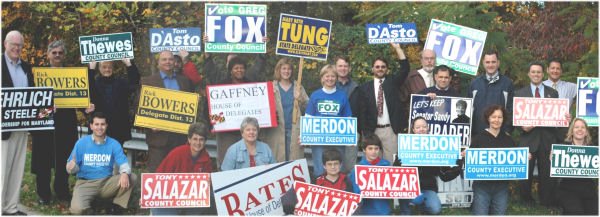
Hey Chris Merdon (back row, third from the right), where's your sign?
Let me get this out of the way first: I generally agree with the citizens' assertion in the current case involving expansion at Turf Valley that the development should be subject to the county's Adequate Public Facilities Ordinance. I'm not sure why the community was exempted from the growth control measure in the first place--the article provides no real answer--but removing the exemption seems, at least superficially, like a good thing to do. Unfortunately, I don't think the Planning Board has that power.
So, with that said, I have a couple of not-entirely-relevant comments on this story.
First, what's with the story lede? Here are the first five sentences.
A referee will mercifully stop a fight when a boxer is being pummeled. Although the battle over the planned expansion of Turf Valley is the zoning equivalent to a 15-round heavyweight bout, there are no provisions for compassion, which means one party will ultimately go down for the count.
As things stand now, the developer, Mangione Family Enterprises, appears well ahead.
"I think that's a fair conclusion," said Marc Norman, co-chairman of an opposition coalition. "But we have not had the opportunity to present our case yet."
Although I disagree with the use of a cliched boxing metaphor on principle alone, it's use in this story does nothing to enhance the point; in fact, it actually hurts the writer's (for this story the by-line is simply "A Sun Reporter") ability to convey what's going on. For instance, the first sentence talks about a referee calling an end to a fight when one boxer is getting "pummeled." Is it really fair to say the citizens are being pummeled at this point? Sure, they may have had some setbacks, but such quasi-judicial development cases are often characterized by setbacks faced by both sides. Moreover, as Norman said, the citizens haven't had an opportunity to present their case, or in the parlance of the boxing metaphor, they haven't thrown a punch. If two boxers enter a ring and one lands a couple of early punches, is it fair to call this a pummeling? Probably not.
The second point I'd like to make focuses more on the process used to decide these case. Many development proposals go through a quasi-judicial hearing process before either the Planning Board or Zoning Board. In these settings, there are always two clearly-defined sides. Usually, the citizens and the developer. Intrinsic antagonism between the two sides is reinforced by the process, as the presiding board and participants are segregated by procedural rules into clearly defined roles, elminating any middle ground.
I know this process has its benefits, but it also has some serious drawbacks. It offers no chance for dialogue. It is a confusing process that requires serious knowledge of arcane procedures and limits public input. And it is weighted heavily in favor of the developers, who can pay lawyers to spend many hours preparing for a case. Here's a quote from the developer of Turf Valley:"I have a very good attorney. He spends a lot of time preparing, and he anticipates a lot of things," (Louis) Mangione said. "He does what he has to do to keep the project moving."
Finally, this process also leads to the sad outcome predicted for Turf Valley by the opposition leader.
While professing optimism, Norman also said there's a contingency: "There is a high likelihood that this case will be tied up in the courts for years."
There has to be a better way.
That's right. It's time for the second ever installment of News Roundup.
But first, this post had me thinking about suburbia for the past few days. Alas, my pondering mind rendered nothing of worthy of posting, but my activities today, which were not atypical for an average Saturday, say much about why I and others like me have found the good life in the 'burbs.
Here are the relevant details of today (thus far):
Morning: Wake up.
Mid-morning: Eat breakfast. Read papers. Browse internet. Finish reading book that I fell asleep with last night.
Noonish: Go hiking with my dog.
Mid-afternoon: Return from hike (roughly 8 miles, the majority of which was spent trekking over earthen trails beneath increasingly leaf-less trees along ridges and floodplains overlooking both local branches of the Patuxent--even spent some time letting the pooch dip in the chilly waters of the rivers' confluence).
Later than mid-afternoon: Deposit check in ATM. Grab a slice of pizza. Purchase some items from drug store. Pick up shirts from the dry cleaners.
Now: blog.
Total miles driven: 0.
As you can see, life in suburbia--under the tyranny of the automobile--is absolute misery.
Anyway, onto the news, which is still regrettably slow. Come on, Sun. Bring us something juicy tomorrow, even if you have to make it up.
Interesting news on the anti-smoking bill. It might not pass, but I don't think the politicians who favor the bill (Robey, Ulman, and Guzzone) are terribly upset. After all, they will benefit just by supporting this legislation, which, judging from the mostly supportive letters to the editor in local papers, I think is popular. Ulman sums up the situation by saying if the bill dies "it's something for people to talk about and think about as they decide who to support in the next election."
Something all politicians can agree on: A committee studying the salaries of HoCo's politicians voted to support pay increases for both the council and executive. While the 44 percent council pay raises sound substantial--and certainly the headline and reporting lean towards sensationalism--$49,000 a year does not seem excessive, and the 44 percent increase doesn't sound as significant when considering the salaries haven't gone up in several years. Indeed, in 1998 council members were making $31,100 a year. If they make $49,000 next year, the total pay increase amounts to less than 6 percent per year (you'll have to trust me on the math). Also, when you consider that HoCo council members earn less than most surrounding jurisdictions--and would continue to after the pay increase--it's really not such a big deal, is it? Here's a good quote from the story: "'Do I think it's necessary to play catch-up? I think it is. They've been behind for years,' panel member Steven Sass of Columbia said at Wednesday's meeting."
Another reason to not want to be buried in a pet cemetery. Since we're on the subject of The Ramones, I'd like to give a shout out to my dad, who took me and my sister, both in our teens, to see The Ramones in concert. Before this he took my younger brother and I to see Metallica's Snake Pit tour. A few years later, he stood with my brother inches from a mosh pit, inspired by the Ozzy Osbourne-less Black Sabbath of the mid-1990s. I'm pretty sure that amidst the flying hair of various headbangers (is it still okay to use that word?) and the distorted cacophony of guitars at these concerts my Dad must have asked what he did wrong. Nevertheless, he endured. And eventually, we grew up.
I'm going to be honest here. I haven't read this, but it looks interesting. I gather that it's about the difficulty of making a living on a farm in Howard County. I'll get around to it.
All in one link: Anti-anti-smoking bill to be introduced (kinda); burning trucks (and I don't mean Paris); unapproved fringe benefits; and tennis anyone/no one? That was easy.
Election talk: Republicans waving at cars with signs. Democrats at odds over governor's race. One thing: Can we call an end to the stand-on-side-of-road-and-wave-at-commuters-on-their-way-to-work style of campaigning? I don't care about politics at 7:30 in the morning, and I certainly don't want to see smiley-faced candidates pretending to be nice while probably cursing the cold/wind/exhaust fumes under their breath. Has anyone looked into whether this is effective? My guess is that it has no impact whatsoever on the outcome of the election. Also, isn't this kind of a metaphor--however strained--for the state of politics in general? That is, superficial. I understand campaigning door-to-door and talking to voters. Doing so can help a politician understand what people really care about. But what good does this serve? Okay, I'm rambling. I'll stop now.
Still the most entertaining section of the Flier: The letters page, filled to overflowing this week.
And finally, happy birthday to West Friendship Elementary. Howard's oldest school turns 80.
I fashion myself as somewhat of a scholar of the suburbs, having lived all of my years in these comfortable, if sometimes bland and mediocre, locales. Apparently, however, the school of My Own Personal Observation is not accredited, and therefore, my hard-earned PhD means little to the outside world. Alas, there are other scholars who are more "respected" and their suburban studies are finally getting some traction within the cozy confines of the Ivory Tower.
Increasingly, if still a bit disdainfully, academia is beginning to pay attention to the 'burbs, home for years now to at least half of all Americans.
"Emerging" is the assessment Robert E. Lang gives to suburban studies on most college campuses. He's the founding director of the Metropolitan Institute on Virginia Tech's satellite campus in Alexandria, Va. The institute is one of a handful of academic think tanks that have sprung up around the country in recent years - including in Maryland - that study suburbia as well as cities.
"Many of these people see the suburbs as the ultimate expression of everything they hate about America," contends California author and social critic Joel Kotkin. A native New Yorker, he has lived in suburban Los Angeles for the past three decades and writes frequently about the suburbs. "Even the people who study suburbia do it mainly to dis it."
"There's a huge bias [against suburbs]," agrees Donald F. Norris, a professor of public policy at the University of Maryland, Baltimore County, situated in another suburban locale, Catonsville. "I've had countless academics in this field tell me, 'I wouldn't live in a suburb. I only live in a city.'"
..."The fictional portrayal of suburbs remains fairly bleak," counters D.J. Waldie, whose nonfiction Holy Land: A Suburban Memoir, recalls growing up in suburban Los Angeles. "It is a convention in American fiction writing to regard suburban places as problematic at best and as horrific at worst."
The past few weeks have been pretty slow, news-wise anyway. So, I'm reaching deep down into my bag of tricks to pull out a couple of posts that would be pushed aside during the normal rush of covering the day-to-day affairs of the county of Howard. Today's topic: Newspapers and the internet.
Despite being named by USA Today as the second most "tech-savvy" county in the country, Howard County suffers from information underload. And for this, I fault the local papers that have failed to take advantage of widely available information technology. Sure, many bloggers have made a cottage industry out of denouncing the media for failing to keep pace with the times, and I don't really have much to add to the discussion.
However, one salient point I'd like to make is that newspapers today and in the future should shift their focus from being a source of information to a portal to information. Instead of being an end for internet browsers, they should become an entry, linking to various pertinent outside information (studies, source information, blogs) that would enhance a readers understanding of a particular story while at the same time making the paper an invaluable tool for information collection and dissemination. With the ease at which information can be found and linked to--after all, if I can learn to hyperlink, anyone can--it makes no sense to me that they still view stories as a end and not a means to greater understanding.
So, how do Howard's rags stack up with the needs of the "information age?" From best to worst:
The Washington Post: In the main section of the post, stories that are cited by blogs usually have a box pop up to show readers what others are saying about the story. For instance, see this story which I blogged about here. Not too shabby, eh? The Post also does a pretty good job of creating discussion forums and having on-line chats, but the stories still lack links to other pertinent sources of information. Meanwhile the Post's Howard Section has a pretty good list of links to sites of interest for county residents (schools, government, traffic, etc), though there are often stories in this section that only tangentially apply to the county. For instance. However, I imagine they have to fill the space and if there are no local stories, a state story isn't a bad second choice.
The Baltimore Sun: Although the Sun generally does a better job of covering Howard issues, their site lags behind the Post in connecting the information dots. To be sure, there is a "Howard Survival Guide" with static information about the county and some stories have embedded links to internal pages (such as one describing Ellicott City). But, on the whole, the paper still sees itself as an end not a means.
The Business Monthly: I recently added a link to this local publication because I think it's reporting is very good and the range of stories it covers is the best of the bunch. It's website is pretty difficult to navigate, but since it only comes out monthly (really?), I'll cut it some slack.
Patuxent Publishing and The View: These papers are standard local papers, and they're good at what they do, which is publishing stories of local interest on dead trees. Both of their websites, however, stink. While The View has marginally better production values, they both could really use complete overhauls. I understand that websites cost money and these papers don't have much of it, although Patuxent is owned by the Sun, which is owned by the Tribune Co. However, a new website and better system for conveying information--their job--should be looked at as an investment that will pay off in the long run.
So, what's the point of this? The point is that I think with minor changes our newspapers could do a much better job of informing residents about issues affecting the county. Why do Patuxent and The View feel compelled to limit themselves to weekly updates? Why not put bi-weekly or (god forbid) daily updates on their sites and turn themselves into invaluable information resources and generate lots more traffic (and ad revenue)? How about putting up a blog or two, or sponsor a forum where residents can make their own blogs or participate in discussions? At the very least, Patuxent could update its site template, which has remained unchanged for as long as I've been reading it on-line--more than five years, at least.
If we're really such a tech-savvy county, why not cater to our needs? I almost never read the print edition of the papers, and I have a feeling I'm not the only one. Failing to understand and respond to this trend will ultimately harm to the print media, but unlike other bloggers, I'm not going to starting writing a eulogy for newspapers...yet.
Here's a list from the Howard Section of the Washington Post of the worst mid-Atlantic hurricanes.
Noticeably absent is Hurricane Agnes, which I thought was sort of used as a benchmark for the area. But what do I know?
Time for football. Here's to a season no longer plagued with expectations.
More soon.
Here's a well-written response to the boob who wrote a couple of weeks ago in the Flier about how Giant Food hates suburbia--well, it at least makes us pay more for stuff than it makes District residents pay.
Actually, only because I'm a stickler, what Giant is doing is technically called price discrimination. But that's a principle of microeconomics, and not the type of discrimination the first writer was implying (or even knows about).Grocery chain's pricing follows economic principles
The letter from (Hayduke--name left out to protect the foolish), "Giant stereotypes customers according to where they live," compares Giant's prices in the District of Columbia and the suburbs. To him, the difference somehow suggests a focus on the monetary status and sophistication of residents: D.C. is poor and unsophisticated, while suburbanites are rich and sophisticated.
Perhaps the true discrimination comes from (the guy)'s assumptions on the correlation of sophistication and monetary worth.
The fact is that Giant researched the market and determined how much it could profit based upon what the market could bear. That's the law of supply and demand.
Although many people may not have heard of him, Robert Tennenbaum is a bit of a Columbia icon. After all, he was there at the beginning as a planner employed by James Rouse. Tennenbaum is still active in issues affecting the community, and played a significant role in the Charrette. But he's got some concerns (two links), particularly about the idea of demolishing the Columbia Association headquarters building, which is also home to Clyde's, the iconic Columbia restaurant. From the first link:
The lakefront is the iconic image of Columbia and as such the entire urban design of the lakefront should be preserved as is. The Exhibit building, Columbia Association headquarters building, American Cities Building and the General Growth Properties Inc. headquarters building were designed to be in scale with each other, the trees and the lake. Frank Gehry, now a world-famous architect, designed two of the buildings to respect the urban design of the ensemble. Jim Rouse followed the design process and approved it.
Amazingly, the proposed demolition completely ignores the fact that Clyde's and Tomato Palace would be sacrificed. Both restaurant/cafes are a vital part of the social fabric of Columbia. Clyde's, celebrating its 30th year, and Tomato Palace are exactly the kind of restaurant/cafe that the charrette plan believes is vital for a vibrant Town Center. But the plan sacrifices them for a "view."
The demolition idea and the sketch depicting the silly church steeple building replacing the CA headquarters building should be trashed.
I love the honesty, though I don't fully agree with his position. I think the building could go, and Clyde's could be preserved by moving either to another location or to whatever is built in place of this old building. That said, I don't think we need less buildings around the lake, and I don't particularly buy into the idea that we need vistas of the lake, aside from those afforded in pedestrian plazas, which we already have. I just think we could demolish the building (and even the American City Building for that matter) in favor of some nicer architecture.
From the second link above, Tennenbaum writes in the Flier:
The charrette process (and the General Growth Properties Inc. process) educated residents about what constitutes a vibrant town center.
However, I have reservations.
Phasing was ignored. If proposed development is scattered, residents will have a long wait for a vibrant Town Center. A phased "smart growth" plan should be developed to assure development of the Warfield Triangle, the Corporate Boulevard and core "infill" sites before development on the Crescent Site. This would create a critical mass of residents and retail activities sooner for today's residents to enjoy.
The county, the Columbia Association and General Growth should develop a coordinated plan to implement pedestrian circulation improvements that can be accomplished soon, such as sidewalks, pathways, crosswalks, signage, lighting, landscaping and traffic signals. This will show progress.
I agree that we need to actually plan how we're going to implement our plan, and we certainly need to make sure that we start seeing the good things--new pedestrian connections, better signs, etc--at the same time we're forced to look at some, er, not-so-good things. And I think it's great that we're talking about all of this now, instead of when the process has moved too far along.
Larry Carson writes today about the local bills that Howard County would like the state General Assembly to approve.
Like an aging rock star's "Best of ..." album, the list of Howard County bills proposed for General Assembly approval in January - the last session of this four-year term - is peppered with the legislative version of oldies but goodies.
Seven of the 19 local bills scheduled for a hearing in Ellicott City Nov. 29 are repeats from last year.The House delegation chairman, Del. Shane E. Pendergrass, a Democrat, said her plan is first to consider three local bills approved by the delegation last year, but which failed for various reasons to get full General Assembly approval.
Next might come six requests for state bond funding for local projects, "since they're pretty uncontroversial," she said. Then could come repeat bills defeated last year, and finally new measures.
"I'm trying to determine how to efficiently work through the job we have to do and make it convenient for citizens," she said.
I'm glad Del. Pendergrass is trying to make this process run more smoothly. I attended the hearing last year, and it was definitely a lot to get through in one night (I seem to recall having to miss most of a Terps basketball game, which was very unfortunate). Also, last year was memorable for the fact that the delegation and General Growth Vice President Dennis Miller almost came to blows, but that's a whole other story.
Back to this year's slate of bills, I quickly perused them and didn't see anything particularly noteworthy--at least aside from what Larry writes about (read the whole thing). The bill banning steel leg-hold traps is likely to generate a lot of testimony, and if past is prologue, almost all of this testimony will come from interest groups (hunters vs. animal-rights folks) located outside the county. To them I say, mind your own business.
To view the list of bills, visit the county's State Delegation website. I'm sure I'll write more about these bills as the hearing and General Assembly session near.
I, um, forgot that I'm wearing my musician hat tonight. So, this is all you'll get.
Since I'm wearing the same hat tomorrow night, don't expect anything then, either (unless I somehow drag myself out of bed a half an hour early and blog before work).
If you need something to occupy your time between now and my next post, contemplate this:
A Cup of Tea
Nan-in, a Japanese master during the Meiji era (1868-1912), received a university professor who came to inquire about Zen.
Nan-in served tea. He poured his visitor's cup full, and then kept on pouring.
The professor watched the overflow until he no longer could restrain himself. "It is overfull. No more will go in!"
"Like this cup," Nan-in said, "you are full of your own opinions and speculations. How can I show you Zen unless you first empty your cup?"
All for now. More later.Yes, yesterday's hype has become today's let down (desire is the root of all suffering and what not). I've failed to live up to the vaunted headlines from last night--only getting three out of four hard hitting pieces in the Tuesday edition. But you're in luck. Tomorrow promises to be yet another day with only minimal obligations beyond blogging (today's excuse, if you're keeping score, is a friend in need of iPod assistance and a wife in need of company).
So check back for more of the same...only different!
I'm always a little hesitant to rip into letters to the editor because I am generally supportive of people expressing their views in writing, no matter how inane. This week, however, someone wrote a letter that was just too good to pass up. Here is link (scroll all the way down), but for your sake and mine, I'll include the whole thing here:
Where to begin with this one? How about the astounding lack of logical reasoning? Or the total inability to express a point clearly? Or the disturbingly sheltered view of the world?Giant stereotypes customers according to where they live
Judging by their sales fliers, Giant believes that the residents of the District of Columbia are poor and unsophisticated while the residents of the suburbs are rich and sophisticated. In a recent flier, the supermarket chain advertised chicken at some District stores that cost 59 cents a pound while the same product is 79 cents a pound in the suburbs.
Potatoes are 20 percent more expensive, orange juice 16 percent, bathroom tissue at 9 percent, and shrimp $1 more per pound. Apparently, Giant believes the downtrodden District needs help while the rich suburbanites can afford to pay more.
This stereotyping is insulting and discriminatory.
Not content to be one of the first county's in the nation to adopt smoking bans in most restaurants, Howard County is trying to snuff out all indoor smoking.
The measure, which would fine establishments $500 for allowing indoor smoking, is similar to legislation that Montgomery County passed in 2003 and that is under consideration in the District and Prince George's County. If the proposed bans take effect -- which appears likely in at least two of the jurisdictions -- it would create a four-jurisdiction smoke-free zone stretching from the White House almost to Baltimore.
"I just can't wait any longer to ban smoking," said (County Executive Jim) Robey (D), who said he has watched several friends and family members die of smoking-related cancer. "Too many lives are at stake."
Melvin R. Thompson, vice president of government relations for the Restaurant Association of Maryland, said a smoking ban would cripple the state's hospitality industry, particularly small bars and restaurants that depend on loyal smoking customers.
"It might be a small percentage of the entire market," he said. "But this sort of ban can really kill them."
...Thompson said 83 percent of eating and drinking establishments in Howard prohibit smoking as a result of that measure. He questioned why additional restrictions were necessary when so few businesses allow smoking.
According to the U.S. Census Bureau, there are currently over 1600 mobile homes in Howard County, down from more than 1800 in 2000. And the downward trend will continue, as mobile home parks, such as Beechcrest, are being demolished in favor of more permanent housing.
The hoped-for revitalization of U.S. 1 received another boost with the approval of a brief and, on first glance, irrelevant change to the voluminous zoning regulations.
The amendment, though, was the initial step in replacing a mobile home park with an apartment complex in North Laurel.

Although there are many stages left in the development process, the president of Beechcrest Mobile Home Estates, Mirza Baig, said the apartments would serve two county objectives: beefing up the historic U.S. 1 corridor, large parts of which have over the years fallen into economic disrepair, and providing moderately priced housing.
On the whole, replacing mobile home parks with apartments is something we should welcome, particularly along the beleaguered Route 1 corridor, where revitalization has been slow in coming, though not for lack of effort. However, while our remaining mobile home parks will likely be replaced by additional housing that is also affordable and in better condition, it isn't hard for me to muster some sentimental feelings for these remnants of Howard's past.